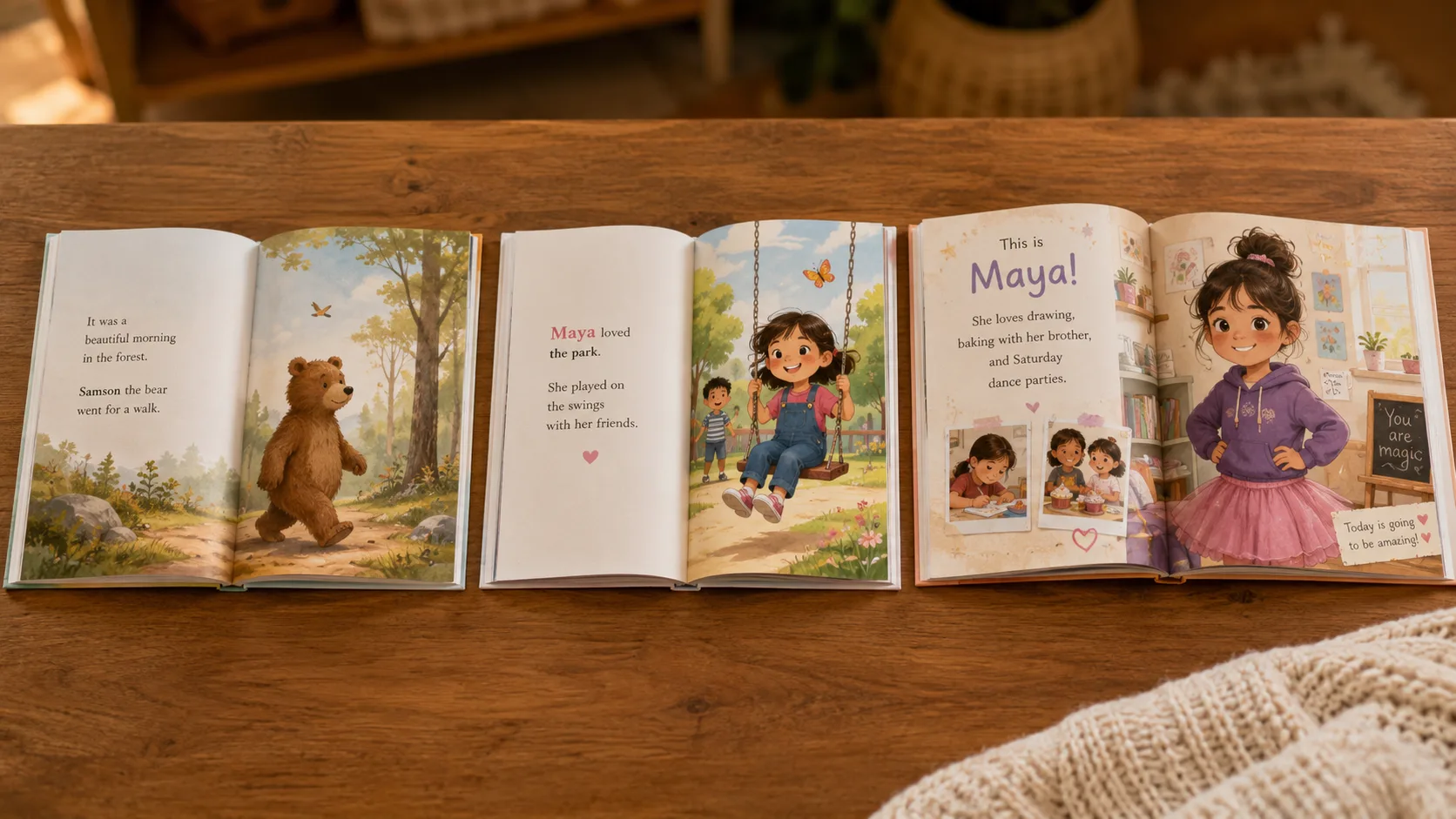
Most comparisons between personalized and regular children's books collapse two very different things into one category. A book with a child's name on the cover is not the same as a book built around that child's identity. The comparison table in this article treats them separately — because the child's experience of reading them is genuinely different.
Neither type is universally better. Regular books provide literary breadth, vocabulary exposure, and a shared cultural reading experience. Truly personalized books provide stronger self-reference engagement, higher re-read motivation, and a more effective intervention for resistant readers. A labelled book — name on cover, generic inside — does neither well. The right choice depends on the child, their age, and the specific purpose you are choosing a book for.
Before comparing, three categories need to be defined clearly — because the word "personalized" covers a wide range of products, and that range matters.
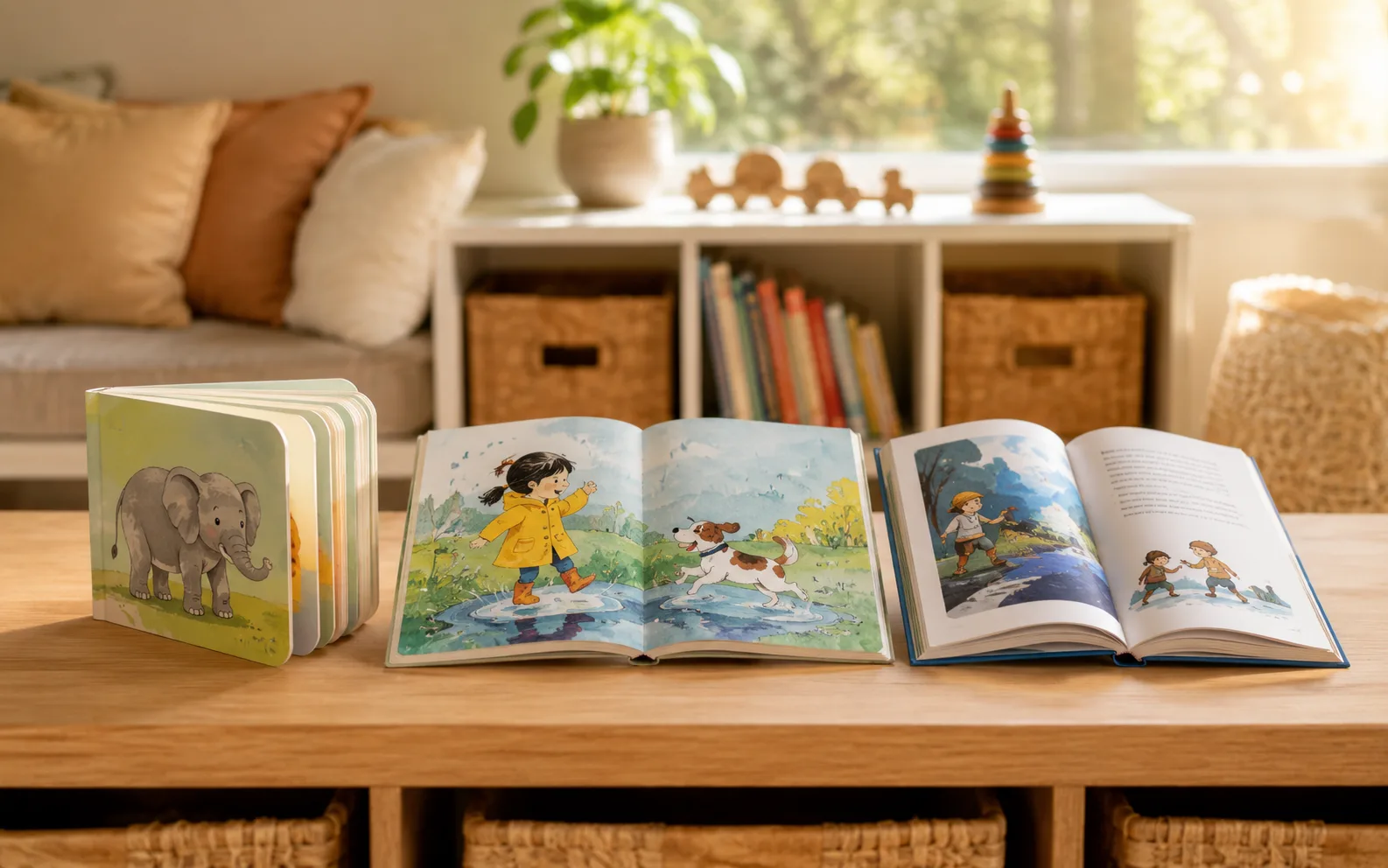
A regular children's book is a professionally published story written by an author and illustrated for a general audience. It does not include the child's name, details, or identity.
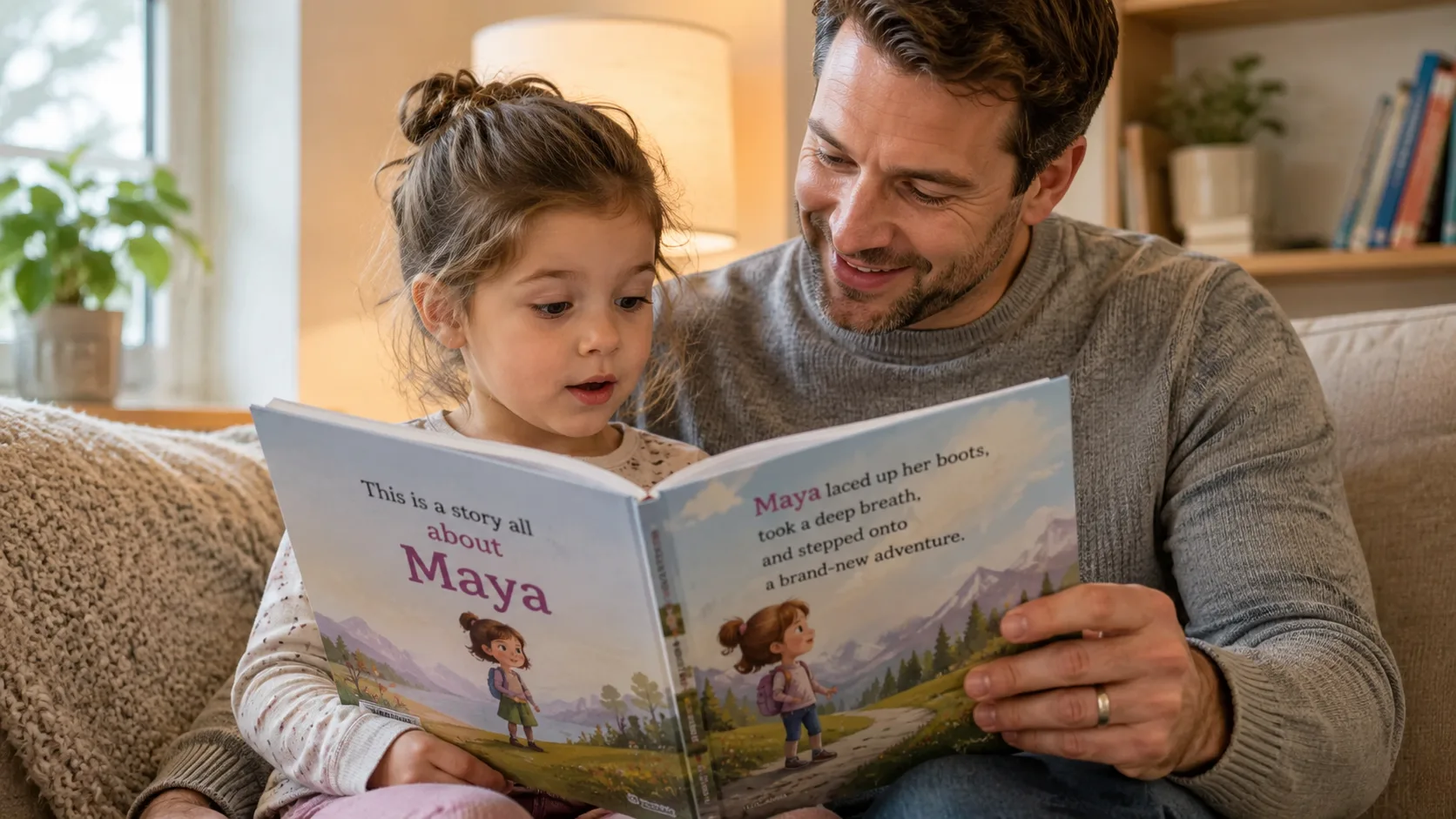
A labelled personalized book inserts the child's name into a pre-written story where the plot and content are otherwise unchanged. The name appears on the cover and in the text, but replacing it with any other name would leave the story identical.
A truly personalized story integrates the child's details — name, age, personality, interests, story role — into the narrative so that the child's specific characteristics affect what happens. The story would not work with a different child's details.
The 3-Way Comparison: What Actually Changes
The following table compares all three book types across seven dimensions that matter to parents and children. The research basis for each dimension is noted below the table.
| Dimension | Regular book | Labelled personalized | Truly personalized story |
|---|---|---|---|
| Self-reference effect | Low. Child observes a story about others. Lowest |
Mild. Name recognition only; story is not about this child. Partial |
High. Child's details are embedded in plot events. Self-reference effect fully activated. Strongest |
| Vocabulary & language exposure | High. Quality authors write with rich, varied vocabulary deliberately above the child's current level. Strongest |
Variable. Depends on the quality of the base story before personalization. Variable |
Variable. Depends on writing quality. Often less rich vocabulary than curated picture books. Variable |
| Re-read motivation | Moderate. Children re-read favourites, but motivation typically decreases with each pass. Moderate |
Low after first read. Novelty of name fades quickly without story quality. Fades fastest |
High. Self-recognition maintains re-read interest longer; each re-read reinforces identity. Strongest |
| Pre-reading resistance | Cannot address pre-reading resistance. Child must already be willing to start. No effect |
Brief disruption only. Name curiosity fades within the first page. Brief effect |
Strongest for disrupting the pre-reading decision. Story is immediately relevant before the child decides whether to engage. Strongest |
| Narrative breadth | Wide. Regular books expose children to diverse settings, cultures, characters, and perspectives. Strongest |
Narrow. Story content is designed around a template for personalization. Narrowest |
Narrow. Story is necessarily centred on the child's world and identity. Narrowest |
| Shared reading value | High. Quality books read aloud support vocabulary, comprehension, and parent-child bonding simultaneously. Strongest |
Moderate. Name novelty can spark engagement for a shared reading session. Moderate |
High for first reading. Child's engagement amplifies the shared reading experience. Strong first read |
| Keepsake value | Variable. A beloved regular book becomes a keepsake through emotional connection over time. Earned |
Low. A labelled book is a label, not a memory. Lowest |
High. A story genuinely about a child at a specific age captures who they were, not just their name. Strongest |
The research basis for these dimensions: self-reference effect documented in Rogers, Kuiper & Kirker, University of Waterloo, 1977.[1] Vocabulary exposure from reading documented in Cunningham & Stanovich, 1998 at Oakland University.[2] Re-read motivation and reading engagement documented in Guthrie & Wigfield, 2000 at the University of Maryland.[3] Shared reading benefits documented in the meta-analysis by Bus, van IJzendoorn & Pellegrini, Leiden University, 1995.[4]
The self-reference advantage for truly personalized books rests on extrapolation from memory psychology research, not on randomized controlled trials of personalized books specifically. The table reflects what research on the underlying mechanisms supports, not what has been proven in direct comparisons of book types in children.
Regular books have stronger direct evidence for vocabulary and comprehension development because they have been the subject of decades of reading research. Personalized books are newer and less studied. This does not mean they are less effective for their specific purpose — it means the evidence base is different in kind.
When Each Type Wins
The comparison table shows dimensions in isolation. This section shows specific use cases where one type outperforms the others — and where the choice is not clear-cut.
Daily reading library and read-aloud sessions
For building vocabulary, narrative breadth, and a wide reading life. Quality authors writing for children provide richer language than most personalized book providers. For the regular reading diet, regular books are irreplaceable.
Reluctant reader — first engagement
For a child who resists books because they feel irrelevant, a story that is unmistakably about them addresses the pre-reading barrier that a regular book cannot. This is the specific context where personalized books have their strongest advantage.
Gift for a specific child at a specific age
A story that captures who a child is at age six — their obsessions, their humor, their name in the plot — becomes a keepsake in a way a generic book cannot. Personalized books are particularly effective as birthday and milestone gifts.
Bedtime reading ritual
A personalized book can start or restart a bedtime reading habit by making the experience feel immediately relevant. But sustained bedtime reading over months and years needs a library of regular books — a personalized story loses novelty faster than quality regular books do.
What Regular Books Do Better — An Honest Account
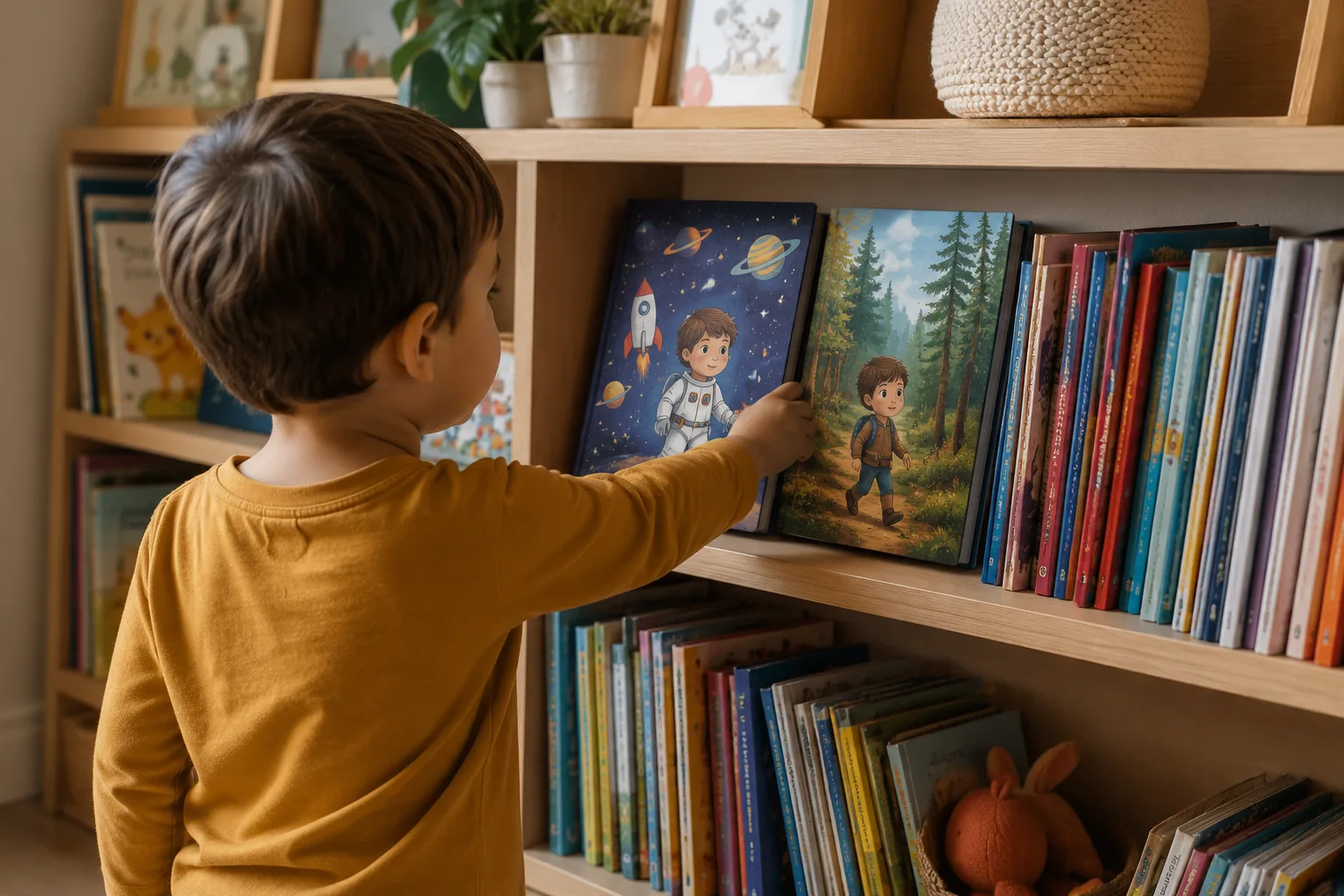
This section exists because most content comparing personalized and regular books omits it. Balanced claims matter — a parent reading only the personalized books case is not equipped to make a good choice for their child.
Vocabulary range. Quality children's authors — Roald Dahl, Julia Donaldson, Dr. Seuss, Oliver Jeffers — write with deliberate vocabulary choice, sentence rhythm, and narrative structure developed over careers and refined through editorial processes. Research by Cunningham and Stanovich (Oakland University, 1998) documents that the volume and quality of reading exposure is one of the strongest predictors of vocabulary development in children.[2] Personalized books, typically written as products rather than literary works, rarely match this standard.
Diverse perspectives and world-building. A library of regular books exposes children to diverse characters, settings, time periods, cultures, and moral situations. Personalized books are necessarily self-centred — the story is always about this particular child. That is a strength for motivation; it is a limitation for the breadth of a reading life.
The shared cultural experience of beloved books. A child who knows The Gruffalo, Charlotte's Web, or The Enormous Crocodile shares those stories with other children, with parents, with teachers. This shared reading culture is a social benefit of regular books that personalized books cannot provide.
Why Narrative Transportation Changes with Personalization
One of the mechanisms that makes truly personalized books different from both regular and labelled books is narrative transportation — the psychological experience of being drawn into a story's world.
Research by Green and Brock at Ohio State University (2000) demonstrated that narrative transportation — the degree to which a reader is absorbed into a story — is strongly predicted by identification with the protagonist.[5] The more a reader feels that the protagonist is like them, the deeper the transportation. A child who is the protagonist is not identifying with a character similar to them — they are the character. This produces a qualitatively different reading experience, not merely a stronger version of the same one.
The mechanism explains why labelled books tend to disappoint: the name triggers an initial curiosity response, but the moment the story begins and the child is a passive bystander in a generic plot, the transportation collapses. The name raised an expectation that the story did not fulfil.
A story where your child is the protagonist — not just the named owner.
We make one. Enter their name, age, interests, and a few things that are genuinely theirs. Preview the inside pages. Confirm it is about them specifically — then decide.
Preview Their Story