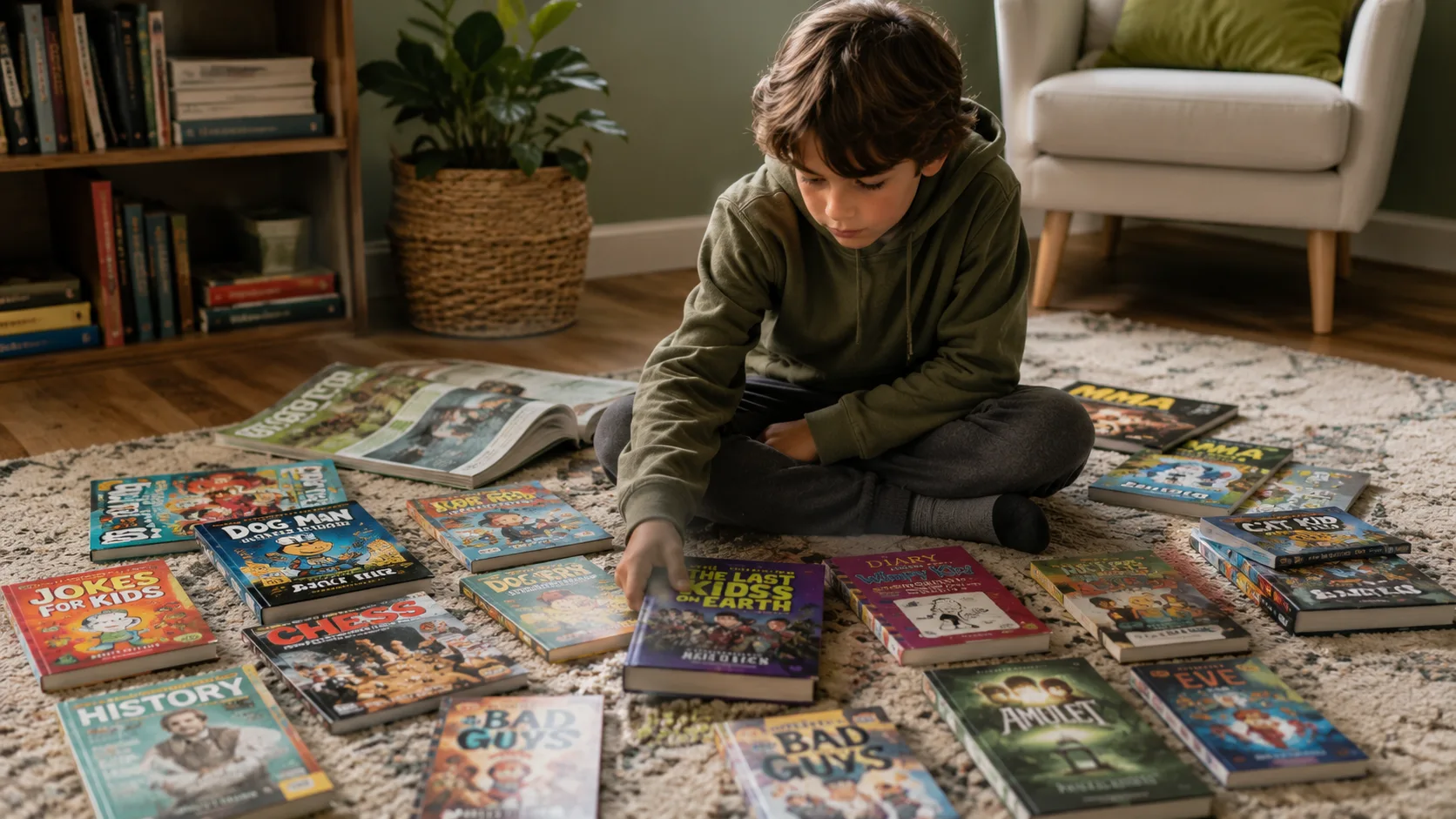


You have probably tried the obvious things. You read to them. You bought interesting books. You showed them you read for pleasure yourself. And the child still refuses. The frustrating truth is that pushing harder from here usually makes things worse. The good news is that the four tactics below — based on what reading research actually supports — are gentler than what you have already tried. Some take less effort than the things that have not worked.
Four low-pressure tactics, ordered from lowest effort to highest: environment (change the surroundings before changing the child), choice (give them real autonomy over what they read), audio (use audiobooks as a bridge to print), and shorter sessions (five productive minutes beats thirty forced ones). If none of these shift things over a few weeks, the next step is professional assessment — not more pressure.
Why Pushing Harder Almost Never Works
The reflex when a child resists reading is to add structure: a reading log, a daily reading time, a reward system, a stack of "good books" the child should be reading by their age. These responses are reasonable. They are also among the most reliable ways to deepen a child's resistance.
The research on what motivates sustained reading consistently identifies three psychological needs: autonomy (the child chooses), competence (the child feels capable), and relatedness (the child has positive social associations with reading). When pressure replaces autonomy, when measurement replaces competence, when reading becomes a chore between parent and child rather than something they share — all three needs are undermined at once. The child's resistance is rational. The system has stopped offering them anything that motivates voluntary behavior.
The four tactics that follow address those three needs directly — without adding any structure that signals "this is the chore I am avoiding."
Tactic 1 — Change the Environment
Make the environment more readable; do not change the child.
Before changing what your child reads or how they read, change what surrounds them. The presence and visibility of books — and the calm absence of reading-related pressure — shape reading behavior more reliably than any individual book choice.
- Books visible in the rooms the child actually uses — living room, bedroom, kitchen — not only the bookshelf they never approach.
- A library card and a recurring library visit (weekly is plenty). Library is choice without cost — both stakes are removed.
- Your own book visible. You reading it visibly, not performatively. Children copy what they observe more reliably than what they are told to do.
- Quiet, screen-light moments built into the day where reading is one of several available activities, not the assigned one.
Tactic 2 — Give Them Real Choice
Hand over the decisions you have been making for them.
Many parents who say "I give my child choice" are actually offering a constrained pre-selection — three books the parent thinks are appropriate. That is not the same as autonomy. Real choice means the child decides, including the choice to read formats adults often dismiss as "not real reading."
- The library trip rule: the child fills the bag with anything they want. You bring nothing. Including the comic, the joke book, the magazine, the book about a topic you find tedious. All of it counts as reading.
- Re-reading is allowed and encouraged. A child re-reading the same book for the fifth time is building fluency and vocabulary, not wasting time.
- Stopping a book partway is allowed. Forcing finishes signals that reading is an obligation. It is not.
- Topics the child cares about — including the obsessive narrow ones — are the right topics. Breadth follows interest; it does not precede it.
Tactic 3 — Use Audio as a Bridge
Audiobooks count. Pair them with print where you can.
Audiobooks are sometimes dismissed as a shortcut. They are not. For a reluctant reader, audio carries the comprehension and vocabulary gains of reading without the decoding effort that may be where their resistance actually lives. The dual-modality version — listening while reading along — is particularly useful as a bridge back to print.
- An audiobook subscription (Libby through your local library is free; Audible has a kids subscription). Browse together; let the child pick.
- Audiobooks during car journeys, before bed, while doing crafts — contexts where reading was not on the table anyway.
- Dual modality where the child has the print book open and follows along while listening. The audio carries comprehension when decoding stutters.
- Discussing the audiobook the way you would discuss a film. Story comprehension is the literacy that audiobooks build.

Tactic 4 — Make Sessions Shorter, Not Longer
Five productive minutes beats thirty forced ones.
The instinct when a child reads only briefly is to extend the session. The research on how learning actually consolidates supports the opposite move: shorter sessions, more frequent, with the child ending wanting more rather than relieved to stop.
- End reading sessions while the child still wants to continue. The next session starts with anticipation, not dread.
- Build reading into small windows that already exist — five minutes after teeth-brushing, ten minutes in the car, a chapter before lights-out.
- Track nothing. No minute log, no chapter count, no progress chart. The point is voluntary repetition; measurement undoes it.
- Accept session-to-session variability. A reluctant reader who reads for two minutes today and twenty minutes tomorrow is doing fine. Average length is the wrong metric.
Other Lighter Things Worth Trying
Beyond the four core tactics, a few smaller interventions are worth a mention. Going to a bookshop and letting the child browse with no obligation to buy is often more effective than buying without browsing. Reading the same book together — you read a page, they read a page — removes the lonely effort of reading aloud. Comic books and graphic novels, treated as legitimate reading, count toward the autonomy point above and address the attention point at the same time.
When the "Push Harder" Means Seeking Outside Help
The title of this article is "What to Try Before You Push Harder." There is a real version of pushing harder — and it is not pushing harder on the child. It is pushing harder to get the right professional assessment if the child's resistance is showing signs that the underlying issue is skill-based rather than motivational.
Watch for these specifically. They are not the parent's job to diagnose — only to notice.
- Persistent difficulty sounding out unfamiliar words, well past the age where peers are decoding fluently.
- Reading aloud is laboured even for words the child has seen before; comprehension lags behind oral language ability.
- The child guesses at words from context rather than reading what is on the page.
- A teacher, librarian, or pediatrician has expressed reading concerns.
- Family history of dyslexia or related reading-specific learning differences.
- Significant attention difficulties that affect reading but also clearly affect other sustained tasks.
If any of these apply, the next step is a reading specialist, speech-language pathologist, or your child's pediatrician — not another tactic from this article.
Research by Margaret Snowling (University of Oxford) and Charles Hulme (University of York), 2012 consistently emphasizes that early identification of reading disorders significantly improves long-term outcomes.[5] Earlier identification is better; later identification still helps. The four tactics in this article support motivation. They do not — and cannot — substitute for skilled assessment of skill-level reading challenges. If you suspect a skill issue, the tactics here are not enough. Professional support is.
What to Do This Week
Pick one tactic. Not all four. The temptation to overhaul everything at once is the same instinct that creates pressure — the thing the article is asking you to dial down. The shift you are looking for is gradual.
For the broader context — including the four problem types that drive most reluctant reading — see our companion guide Best Books for Reluctant Readers: Choose by Problem, Not Just Age. For an honest assessment of when personalized books help and when they don't, see Can Personalized Books Help Reluctant Readers?