
A "best books for reluctant readers" list that picks by age is solving the wrong problem. Two seven-year-olds can be reluctant for completely different reasons — and need completely different books. This article maps the four problems that actually drive reading resistance to the book formats that address each one specifically. It is grounded in named research, and it is honest about which type the right answer is not a book at all.
Four problem types drive most reluctant reading: boredom (books feel dull), confidence (the child believes they are not good at reading), decoding difficulty (genuine skill-level reading challenges), and attention (the child cannot sustain focus through long-form text). Each calls for a different book format. Humor and graphic novels address boredom. Short-chapter illustrated novels and audiobook-with-print pairing address confidence. Decoding difficulty needs specialist assessment first, with books as a secondary support. Short-form content — comics, magazines, joke books — addresses attention.
Why "Best Books for Reluctant Readers" Lists Usually Fail
Most curated reluctant-reader lists fail in a predictable way: they recommend books that adults think reluctant readers should want, not books reluctant readers actually choose when given the choice. The gap between those two sets is large.
Research by Jo Worthy and colleagues at the University of Texas at Austin (1999) documented exactly this mismatch.[1] Worthy and her team surveyed nearly 200 sixth-grade students about what they actually wanted to read versus what their schools made available. Students wanted scary stories, comics, magazines, sports books, joke books, and humor series. Schools provided a different set — books selected on literary merit and reading-level criteria. The mismatch was not minor. It was the primary explanation, in the researchers' findings, for why many of the students did not read for pleasure.
This article inverts the usual approach. Rather than recommending titles, it identifies what is in the way for a specific child and matches a category of book to that specific obstacle. The book a parent ultimately picks comes from the library or bookshop — not from a list. The framework decides where to look.
The Four Problem Types — At a Glance
Each card below describes one of the four problems and the format category that addresses it. Detailed sections follow.
Boredom
Confidence
Decoding Difficulty
Attention
Type 1 — Boredom: When Books Feel Dull
The signature: the child can read, does read what is assigned, but never picks up a book voluntarily. They describe books as "boring" without specifics. When pressed, they cannot name a book they liked recently. Their attention wanders within pages even though they have the skill to keep reading.
The most cited research on this problem is from Stephen Krashen, Professor Emeritus at the University of Southern California. His work on Free Voluntary Reading — letting children choose their own material with no testing or requirement attached — synthesizes decades of studies on what reluctant readers actually pick when given the choice.[2] The pattern is consistent: light, accessible, often humorous fiction; series books; magazines; comics. Krashen's argument is that the choice itself is the active ingredient — children who choose freely read more, and that volume of reading produces vocabulary and comprehension gains regardless of whether the chosen material is "literary."
What to look for in the library or bookshop
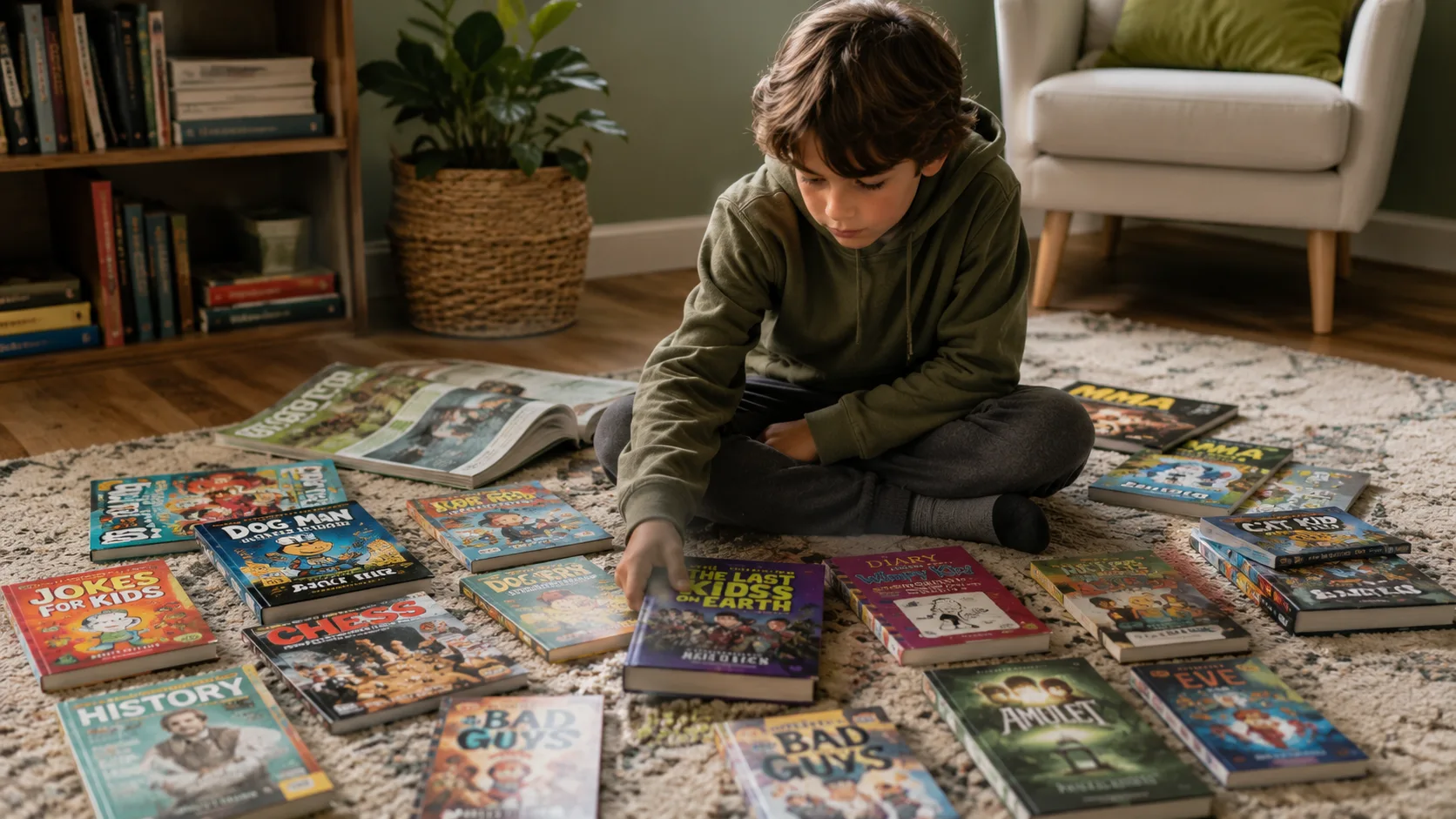
- Humor-driven seriesSeries build loyalty. A child who finished book one has a reason to read book two. Joke books, comedic adventures, silly mystery series. The point is voluntary reading volume — not the literary status of the title.
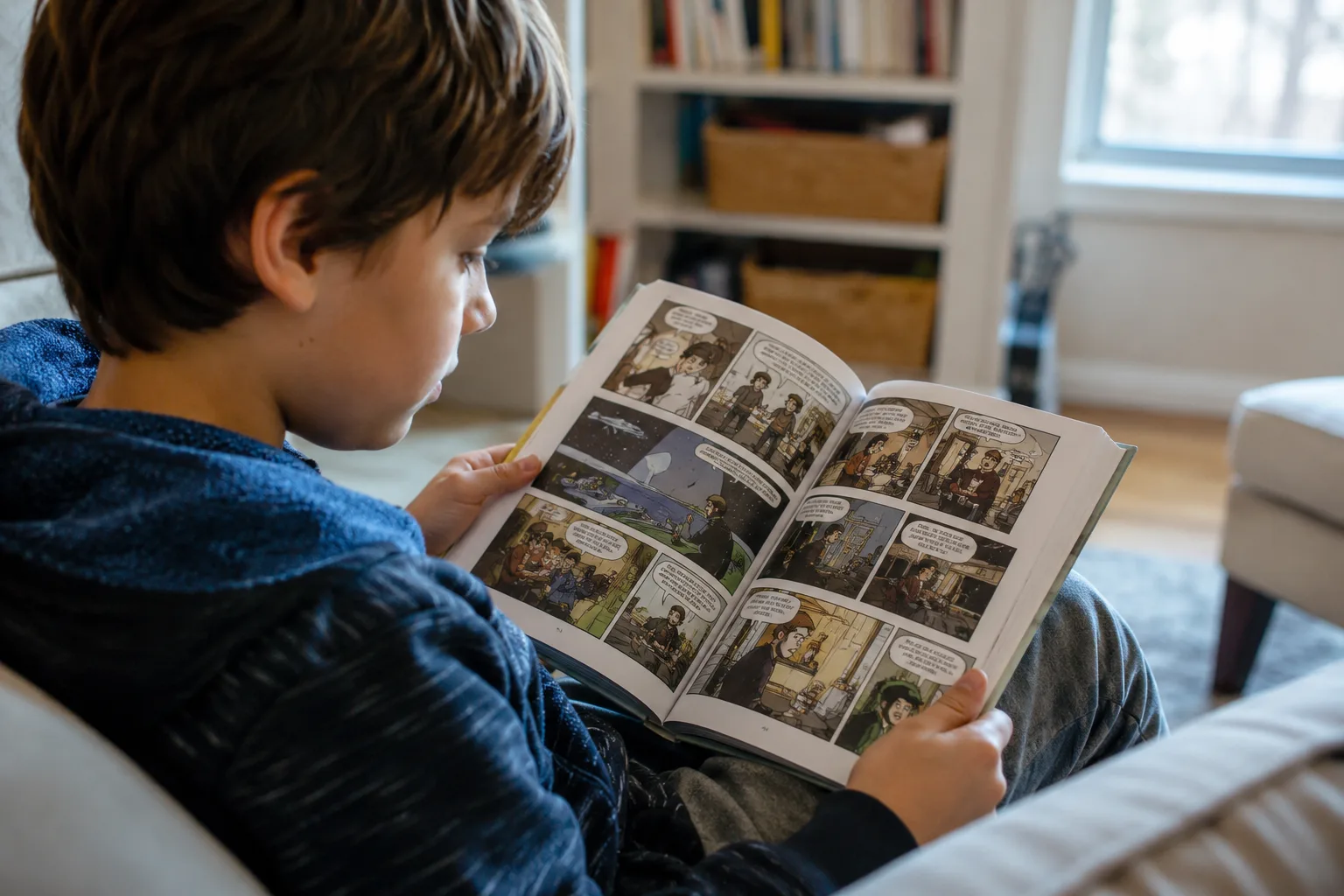
- Graphic novelsShort text blocks remove the wall-of-words barrier. The narrative moves fast. Reading research consistently treats graphic novels as legitimate reading — they require simultaneous processing of text and image and develop sequential visual literacy alongside vocabulary.Krashen 2004 [2]
- Choose-your-own-adventure formatsThe reader controls the story, which addresses both the boredom problem and the passivity problem at once. Particularly effective for the 7–10 age window.
- Magazines on a topic they care aboutCounted as reading. National Geographic Kids, sports magazines, hobby magazines. Real text, real vocabulary, real reading volume.
Type 2 — Confidence: When the Child Believes They Can't
The signature: the child reads adequately when tested, but believes they are "bad at reading." They avoid reading aloud. They put down books quickly when they hit an unfamiliar word. The gap is not in their skill — it is in their self-concept.
Research by John Guthrie and Allan Wigfield at the University of Maryland (2000) identified perceived competence as a core component of reading motivation, alongside interest and autonomy.[3] A child who believes they are not a good reader will avoid reading regardless of their actual skill level — because reading becomes a context where they expect to fail. The goal with this type is not to push them into harder books to build skill; it is to give them experiences where they succeed at reading and gradually rebuild the self-concept.
What to look for to rebuild confidence
- Short-chapter illustrated novelsBooks with 5–10 page chapters and high illustration support create frequent completion moments. Each chapter ends with a small win. The child who is "tired of reading" after a short stretch still finishes a unit.
- Books slightly below their tested levelCounterintuitive but consistently supported in motivation research: a child rebuilding reading confidence benefits more from succeeding at an easier book than from struggling through a harder one. Confidence first, challenge later.Guthrie & Wigfield 2000 [3]
- Audiobook paired with printThe child listens while reading along. Audio carries comprehension when decoding stutters. The pairing rebuilds confidence by letting the child experience successful story-following without the cognitive load of decoding alone.
- Series the child has heard aboutSocial context matters at this age. A book a classmate or sibling liked carries pre-validation. The child is less alone in the choice.
Type 3 — Decoding Difficulty: When the Right Answer Is Not a Book
The signature: the child sounds out words slowly. They guess from context rather than read the actual word. They finish a paragraph and cannot recall what they read. The difficulty does not improve much with practice or with chosen books. There may be signs of a specific reading-related processing difference such as dyslexia.
When the difficulty is genuinely skill-level rather than motivational, the right first step is a reading specialist or speech-language pathologist, not a book recommendation. A child whose decoding is itself the obstacle is not going to read their way out of it with a better book choice. Skilled assessment identifies whether dyslexia, specific language impairment, or another processing difference is the underlying cause — and which interventions match. This article supports motivation; it does not substitute for assessment of skill-based reading challenges.
If you suspect Type 3 — and especially if a teacher has flagged concerns — start with the school's reading specialist or your pediatrician. Books help alongside intervention. They are not the intervention.
For children with confirmed decoding difficulty who are also being supported professionally, certain book characteristics make reading less effortful in the interim. The Mol and Bus (2011) meta-analysis at Leiden University, synthesizing 99 studies on print exposure from infancy to early adulthood, confirms that volume of reading exposure predicts long-term skill development — but only when the effort relative to reward stays favorable.[4] Forcing reading produces resistance, not skill. Lowering the effort barrier so the child still gets exposure produces both.
Book characteristics that lower the effort barrier
- Audiobook with printed text alongsideThe single most useful tool for a child with decoding difficulty. Story comprehension stays high via audio, text and audio reinforce each other, and reading exposure continues during professional intervention.Mol & Bus 2011 [4]
- Dyslexia-friendly font and spacingBooks printed in specifically designed accessible typefaces with wider line spacing reduce the visual effort. Several publishers now offer dyslexia-friendly editions.
- Decodable text matched to current phonics stageSelected by the reading specialist or teacher based on the child's current phonics development, not by parents independently.
- Picture-heavy books well below age levelReading any text is better than reading no text. A confident "easy" experience matters more than chronological age-appropriateness during the support period.
Type 4 — Attention: When Long-Form Loses Them
The signature: the child reads adequately and seems interested briefly, but loses focus within a chapter. They drift after a few pages. They put the book down and forget it exists. The issue is not skill, not confidence, not lack of interest in the topic — it is the format. Sustained narrative does not hold them.
Research by Ulrich Schiefele and colleagues at the University of Bielefeld (2012) distinguishes individual interest (a stable interest in a topic) from situational interest (interest sparked by an immediate stimulus).[5] For Type 4 readers, situational interest works well — short, novel, attention-grabbing content holds them. Building toward sustained reading is a longer project. Volume of any kind of voluntary reading comes first.
Short-form formats that match attention spans
- Comics and comic stripsEach strip is a self-contained micro-narrative. Completion happens in seconds. The reading volume across a comics anthology can be substantial without any sustained-attention demand.
- Joke books and humor anthologiesDesigned to be read in any order, any length of session. The child can read three jokes and stop. That is still reading.Schiefele et al. 2012 [5]
- Magazines and trivia booksShort articles, varied content, visual interest. The format itself signals "this can be put down and picked up freely" — which often results in it being picked up more often.
- Short story anthologiesA complete story in 5–10 minutes. The narrative loop closes before attention drifts.
- Choose-your-own-adventureActive decision points reset attention every few pages. The child stays engaged because they are participating, not just receiving.
When Personalization Disrupts the Decision Entirely
There is a fifth situation worth naming that sits across all four types above. A child who has already decided that books — as a category — are not for them does not respond to a better book from the same category. The pre-reading decision has been made before the first page.
A book where the child is the protagonist sits outside that decision. They have never seen a book in which they are the hero, their name appears in the story text, their specific interests drive the plot. The categorical judgment they made about books was made about other books — not this one. That novelty alone is sometimes the wedge that opens the door.
A story they didn't expect — built specifically for reluctant readers.
Our personalised storybook is humour-first, unmistakably about the child, and designed for the exact moment a child has decided that reading is not for them. It is not a substitute for professional support if the underlying issue is skill-based — and it is not magic. But for a Type 1 or Type 2 child who has not yet seen themselves in a book, it is the format most likely to interrupt the decision.
See the personalised storybookFor a deeper treatment of when this approach works and when it does not, see our companion guide: Can Personalized Books Help Reluctant Readers? When They Work — and When They Don't.
What Does Not Work — An Honest Account
Several approaches are consistently used with reluctant readers and consistently fail, regardless of which of the four types applies. They are included here because most reluctant-reader content omits them, and a parent reading only the positive side is not equipped to make good choices.
Reading logs and minute-counting. Tracking creates an awareness of obligation. The child watches the clock rather than reads. The autonomy that motivates reading — documented in Guthrie and Wigfield's research as a primary motivational driver — is broken by measurement.[3]
Reward charts and bribery. Short-term compliance, long-term cost. Once the reward stops, the reading stops too. The behavioural pattern this builds is "I read because I am paid to" — which crowds out the intrinsic motivation that sustains reading after the rewards end.
Pushing classics or "important" books. A child whose problem is boredom, confidence, or attention will not be converted by being told that a book is culturally significant. The prestige of a title is not an engagement mechanism for an eight-year-old.
Choosing for the child. Even with good intentions, parental choice violates the autonomy principle that the research consistently identifies as motivational. A parent's role is to provide range — many books, many formats, easy access — and let the child select from that range. A library trip where the child picks freely, including the comic, the joke book, and the magazine, produces more reading than a parent-curated stack.
How to Start — A Practical Sequence
For broader treatment of the parent's role in disrupting reading resistance, see our Reluctant Readers resource hub. For a step-by-step approach when the standard advice has not worked, see How to Make Reading Fun for Kids Who Don't Like Books.