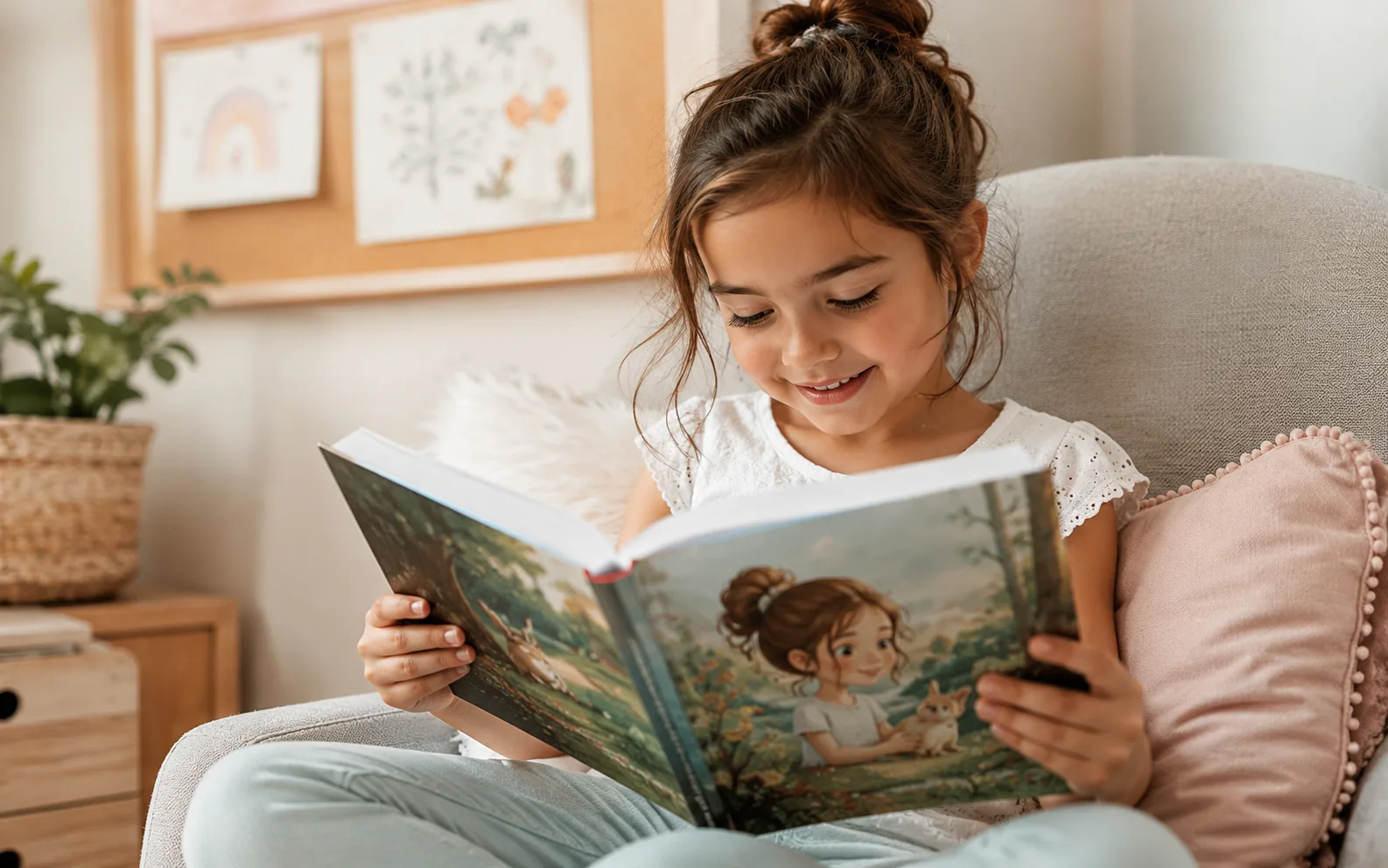
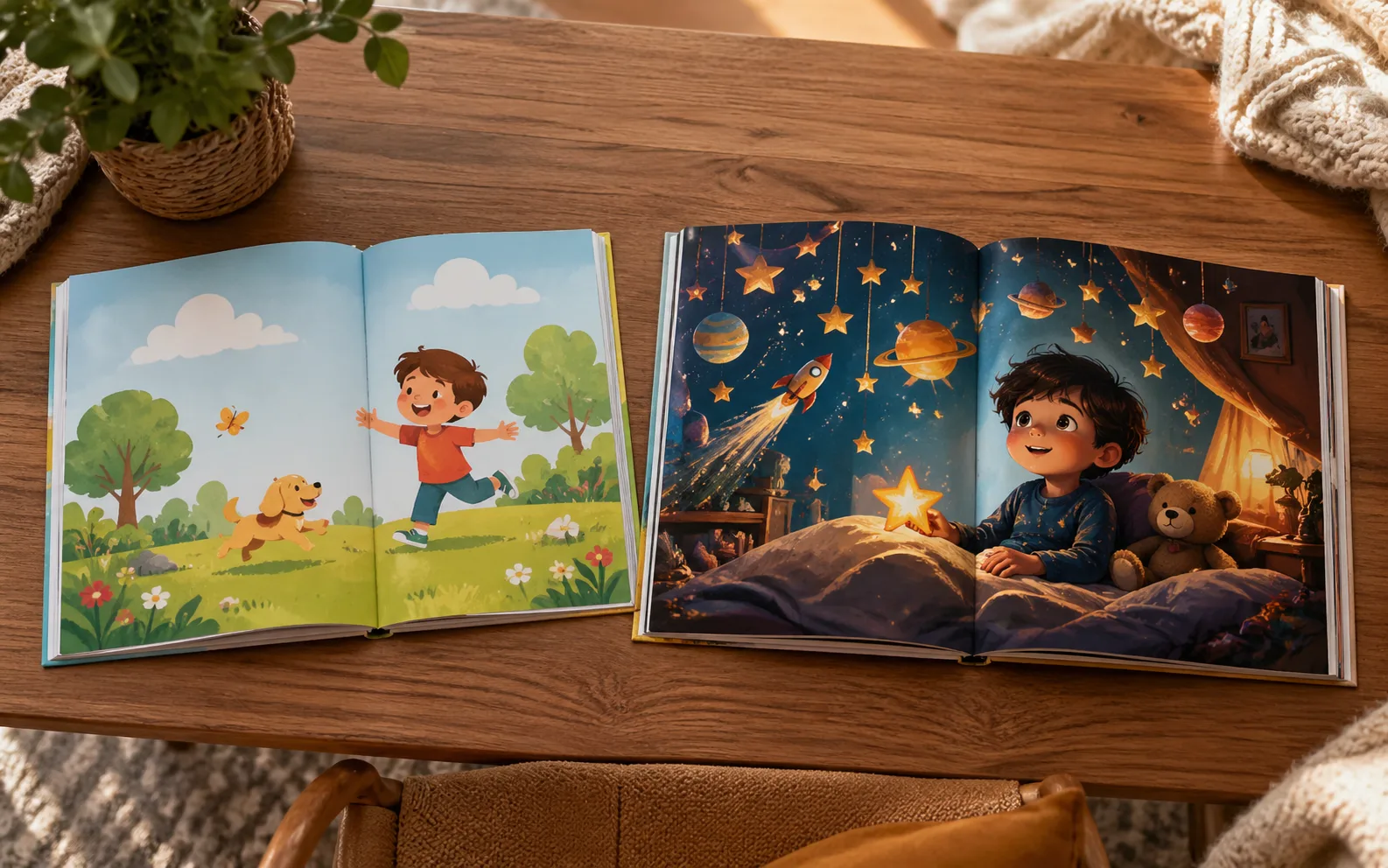
A personalized children's book is one of those gifts where the gap between expectation and reality can be substantial — and the gap shows up the moment the child opens the first page. The name is there. The story is not really about them. This checklist exists so that conversation never happens.
Quick answer
The six areas that cause most buyer regret with personalized books are: the preview (did you see inside pages?), the personalization depth (name-only vs character-integrated), print quality, the typo correction process, delivery timing, and how the provider handles your child's data. All 22 questions in this checklist address one of those six areas specifically.
The impulse to purchase without checking is understandable — a personalized book sounds complete as an idea before you see the execution. But the research on what makes a gift feel meaningful versus disposable is clear: specificity matters far more than intent. Research by Dr. Cassie Mogilner Holmes at UCLA Anderson School of Management (2012) consistently finds that recipients value effort-evidence in gifts over financial value — and evidence of effort means getting the details right, not just getting the idea right.[1]
Use this checklist before ordering any personalized children's book. Each question has a reason behind it.
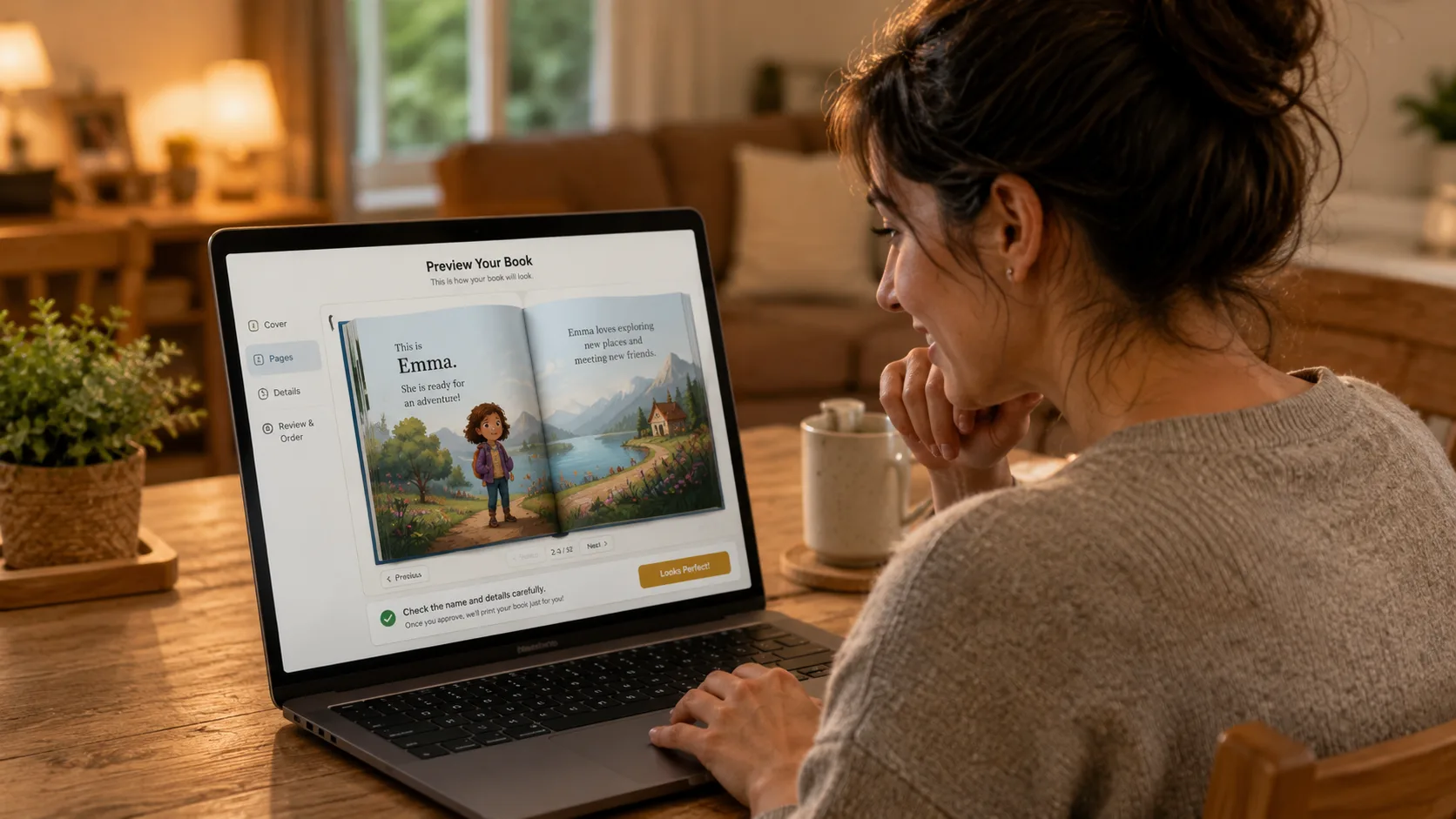
The preview is the moment you can still catch a mistake. If a provider does not offer a preview with your child's actual details applied, that is itself a red flag. Preview stage matters more than any other step — once production begins, text corrections are almost universally unavailable.
A
Preview Accuracy
5 questions — check before paying
Does the preview show real inside pages — not a generic sample?
A preview that shows "Child's Name" as a placeholder is not a preview of your book. It is a template demo. You need to see your child's actual name and details in real story sentences before you confirm the order.
Can you read more than one inside page before paying?
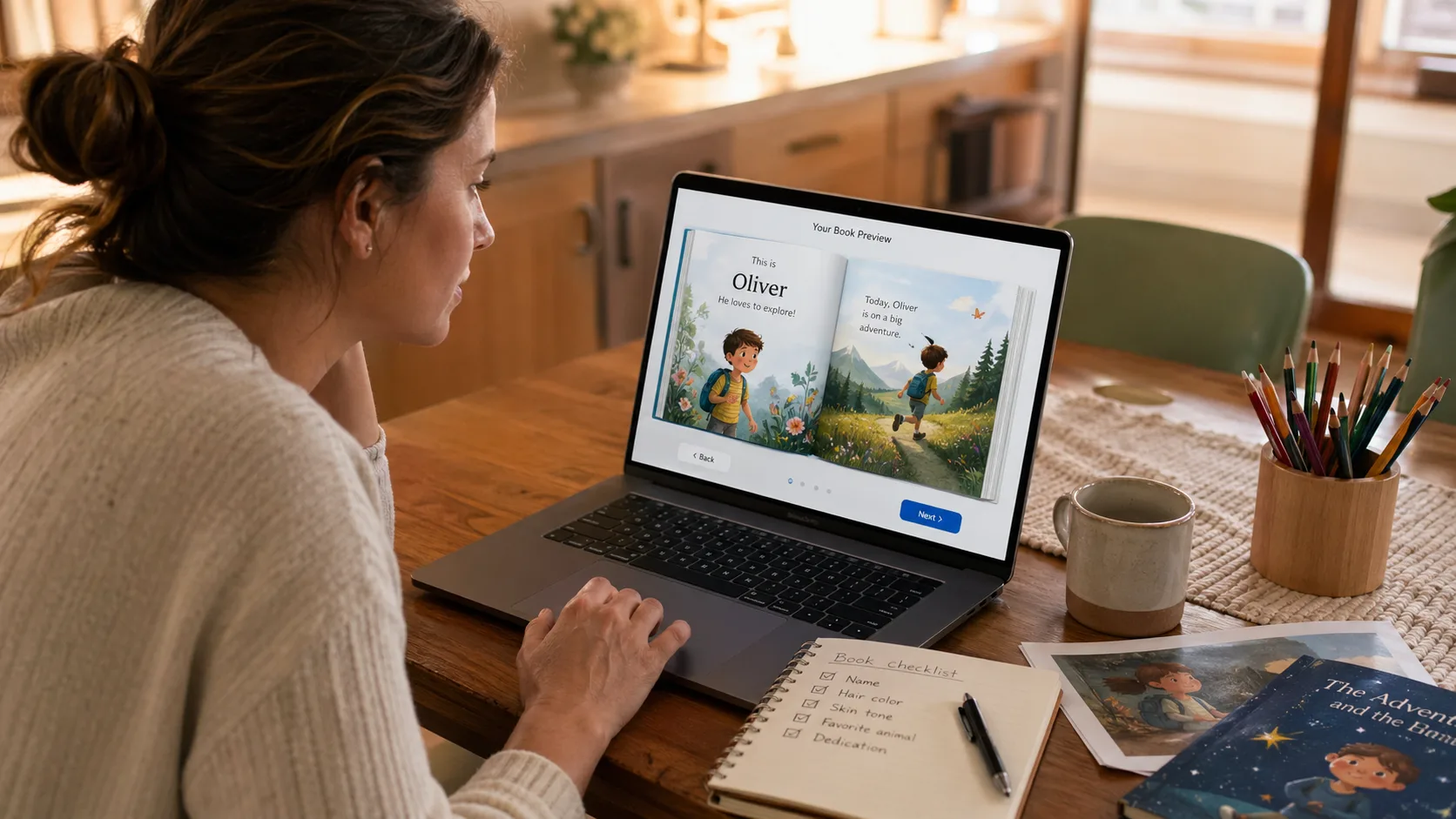
A single preview page may show you the name but not how it integrates. You want to see at least two or three page spreads to assess whether the personalization changes the story or simply labels a generic plot.
Is the child's name spelled correctly in the preview — letter by letter?
Names with unusual spellings (Evie vs Ivy, Leah vs Lea, Elliot vs Elliott) are the most common source of printing errors. Read the name in the preview character by character. Do not assume the system interpreted your input correctly.
Do all other personalized details appear correctly in the preview?
If you entered age, interests, a pet's name, or sibling names, confirm these appear correctly in the preview. Each detail you entered should be traceable to at least one story sentence.
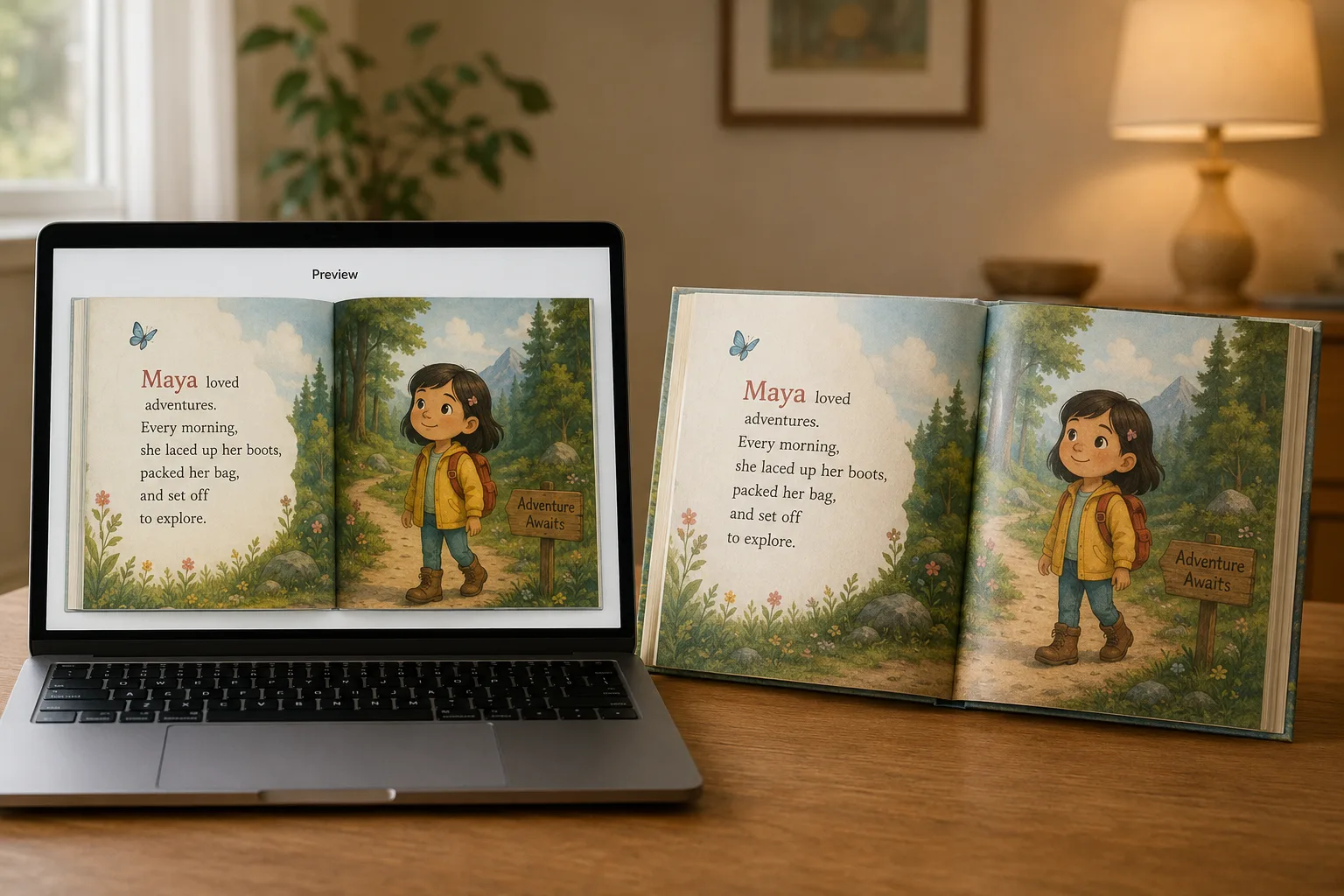
Does the preview look like the printed version, or is it a lower-quality render?
Some providers show a reduced-resolution preview that makes color and text quality look better or worse than the actual print. If you can, find physical sample images in customer reviews to compare.
Category 2 — Personalization Depth
This is where the difference between a labelled book and a genuinely personalized book becomes visible. Research by Rogers, Kuiper & Kirker at the University of Waterloo (1977) established the self-reference effect: information connected to the self is processed more deeply and recalled more accurately than neutral information.[2] For a personalized book to benefit from this effect, the personalization must reach the character level — not just the name field.
B
Personalization Depth
4 questions — does the child affect the story?
Does the child's name appear inside the story as an active character, not just on the cover?
The cover name is a label. The story name is personalization. These are not the same thing, and a child over age four can tell the difference.Rogers et al., 1977 [2]
Do the child's interests or details affect what happens in the plot?
If replacing the child's name with any other name would leave the story unchanged, the personalization is superficial. Look for moments where the child's specific details — their love of dinosaurs, their pet, their age — create a story event.
How many detail fields does the order form accept?
Name-only forms produce name-only books. Forms that ask for age, interests, family details, personality traits, or story tone tend to produce more genuinely personalized stories. More input fields are a proxy for personalization depth.
Is the story age-appropriate for this child specifically?
A story written for a five-year-old delivered to a nine-year-old will feel babyish regardless of personalization quality. Age-appropriate reading level and emotional content matter as much as the personalization itself. Prof. Keith Stanovich (University of Toronto) demonstrated in his Matthew Effects research that reading level match is essential for engagement — level mismatch is one of the strongest predictors of reading disengagement.[3]
The preview should match the print. If customer reviews show a gap between what the preview shows and what arrives, that gap will apply to your order too.
Category 3 — Print Quality & Format
A personalized book is often kept for years — many become family keepsakes. Print quality determines whether the book survives that. The international standard for paper permanence in library-quality documents, ISO 11798 (Information and documentation — Permanence and durability of writing, printing and copying on paper), recommends paper with a minimum weight and alkaline content for permanent records.[4] A children's book does not need archival standards, but these criteria give useful guidance on what separates durable from disposable.
C
Print Quality & Format
4 questions — what physically arrives
Is the paper weight stated on the product page?
90–130 gsm (grams per square metre) is a reasonable quality range for a children's picture book. Below 80 gsm, pages are likely to be translucent and easily damaged. If paper weight is not stated, ask before ordering.
Is the binding sewn, glued, or saddle-stitched?
Sewn bindings last longer under repeated reading and handling by children. Glued (perfect bound) bindings can crack. For a book intended to last years, sewn binding is the better choice when available.
If ordering for a child under 4, is a board book format available?
Standard paper pages do not survive independent reading by toddlers. Board books are printed on thick, laminated cardboard pages. If the provider only offers standard paper for young children, this is a format mismatch for the intended reader.
Do customer reviews mention color accuracy, page warping, or print quality problems?
Print quality is rarely visible in the product images but frequently visible in reviews. Look specifically for comments on: ink smearing, color saturation versus preview, page curling on delivery, and cover lamination quality.
Category 4 — Typo Correction & Accuracy
D
Typo Correction Policy
4 questions — before and after the mistake
Is there a correction window after payment but before production?
Some providers offer 1–2 hours after payment to catch errors before printing begins. This window is your last chance. Know whether it exists and how to use it before you confirm the order.
Does the provider accept a correction or reprint if a name was misspelled in the production process (their error, not yours)?
Production errors — where the provider prints differently from what you entered — should be corrected at no cost. This policy should be stated clearly. If it is not, ask explicitly before ordering.
Does the input form prevent or flag unusual characters, apostrophes, or hyphens in names (O'Brien, Jean-Luc, etc.)?
Names with apostrophes or hyphens often break text rendering systems. Check the preview especially carefully if the child's name contains any non-standard character. If the preview renders incorrectly, the print will too.
Did you read the name in the preview three times before confirming?
Cognitive research on proofreading shows that readers miss familiar errors — especially their own names — because the brain predicts what it expects to see. Reading the name aloud, backwards, and character by character catches errors that silent reading misses.
Category 5 — Delivery & Timing
E
Delivery & Timing
2 questions — especially critical for gifts
Is the confirmed delivery window before your deadline?
Personalized books require production time before shipping. Production time (1–5 business days) plus transit time (2–7 business days) means most providers need 5–12 days minimum. If you are ordering for a birthday or holiday, add a buffer of at least 3 extra days for unexpected delays.
Is expedited or tracked shipping available if your deadline is tight?
If the deadline is close, confirm that expedited shipping is available and what the realistic delivery window is with that option. "Express" shipping can reduce transit time but cannot reduce production time.
Category 6 — Privacy & Data Protection
Ordering a personalized book requires entering your child's name, age, and potentially interests, family members, or location. This is personal data relating to a minor. Under the EU General Data Protection Regulation, Article 13 of the GDPR requires that providers give clear information about how data is collected, used, stored, and shared — before collection takes place.[5] If ordering in the EU, this is a legal right, not a preference.
⚠ Data protection note
If a provider's privacy policy or checkout page does not state clearly what happens to your child's name and details after printing, do not order. "We use your data to create your book" is not sufficient. Ask: Is it stored? For how long? Is it used for machine learning or AI training? Is it shared with print partners?
This applies even for providers outside the EU — these are reasonable questions for any service handling data relating to children.
F
Privacy & Data
3 questions — your child's information
Is it stated clearly what happens to your child's personal details after the book is printed?
Are the details deleted, retained in your account, or used for any other purpose? This should be stated in the privacy policy or pre-checkout summary. If it is not, contact the provider directly before ordering.GDPR Art. 13 [5]
Is it stated whether child data is shared with print production partners or third parties?
Most personalized book companies use third-party print-on-demand services. Your child's name will be processed by that partner. This should be disclosed. If the provider cannot tell you which print partner processes the data, that is a transparency gap.
Is children's data used for AI training, advertising profiling, or marketing?
Children's data carries higher protection obligations in most jurisdictions. A name entered for a personalized book should not be used for profile building, ad targeting, or training a generative AI model. Ask if this is not explicitly excluded in the privacy policy.
◆ About Stattner
Our personalized children's book asks only for the details the story uses. We state clearly in our privacy policy how child data is handled. You preview before paying. We do not use child names or data for marketing or AI training.
If a provider cannot answer every question in Category F clearly, that is the most important signal on this checklist.
If you're ready to order after running the checklist
A personalized book that passes all 22 questions — before you pay.
Preview inside pages with your child's name and details applied. Confirm spelling. See the story. Then decide. No payment until you're satisfied with the preview.
All claims in this article that reference research findings are supported by the sources below. Claims not cited reflect general publishing industry practice or are presented as parent guidance without research attribution.
[1]Mogilner, C., & Norton, M.I. (2016). Time, money, and happiness. Current Opinion in Psychology, 10, 12–16. — Evidence that perceived effort and specificity in gifts increases recipient satisfaction. UCLA Anderson School of Management.
https://doi.org/10.1016/j.copsyc.2015.10.018
[2]Rogers, T.B., Kuiper, N.A., & Kirker, W.S. (1977). Self-reference and the encoding of personal information. Journal of Personality and Social Psychology, 35(9), 677–688. — Foundational study establishing the self-reference effect: self-relevant information is encoded and recalled more deeply than neutral information. University of Waterloo / University of British Columbia.
https://doi.org/10.1037/0022-3514.35.9.677
[3]Stanovich, K.E. (1986). Matthew effects in reading: Some consequences of individual differences in the acquisition of literacy. Reading Research Quarterly, 21(4), 360–407. — Documents how reading level mismatches compound over time; appropriate level match is a prerequisite for engagement. University of Toronto.
https://doi.org/10.1598/RRQ.21.4.1
[4]International Organization for Standardization. (1999). ISO 11798: Information and documentation — Permanence and durability of writing, printing and copying on paper — Requirements and test methods. — Sets criteria for paper permanence in document production contexts.
https://www.iso.org/standard/19960.html
[5]European Parliament and Council. (2016). General Data Protection Regulation (GDPR), Article 13 — Information to be provided where personal data are collected from the data subject. — Legal requirement for transparency about data collection, use, storage, and sharing at the point of collection.
https://gdpr-info.eu/art-13-gdpr/
Before you order
Frequently Asked Questions
Should I preview a personalized book before ordering?
Yes — always. A preview lets you verify how your child's name, age, and interests appear inside the story, not just on the cover. It also lets you catch spelling errors before printing begins. No reputable personalized book provider should require payment before showing you at least sample inside pages with your child's details applied.
What privacy questions should I ask before ordering?
Ask specifically: what child data is collected, how it is stored, whether it is shared with third parties, and how long it is retained. Under GDPR (if ordering from or to the EU), providers must state this clearly. A name and age entered for a book should not be used for marketing or shared with advertising partners. If this information is not clearly stated before checkout, do not order.
Can I correct a spelling mistake after ordering?
In most cases, no — once a personalized book enters production, text changes are not possible. This is why the preview stage matters. Check the child's name spelling character by character. Some providers offer a short correction window after payment but before production begins; ask about this policy specifically before you pay.
What format options should a personalized book offer?
Printed hardcover or softcover books are the most common formats. For toddlers and young children (ages 2–4), ask whether a board book format is available — standard paper pages do not hold up well to young children reading independently. For older children, printed quality and binding matter more than format type.
How do I judge print quality before ordering?
Look for: paper weight stated on the product page (90–130 gsm is a reasonable range for children's books), binding type (sewn lasts longer than glued), and customer reviews that mention color accuracy or page warping. If the provider has no customer reviews and no sample physical images, that is a risk signal before ordering.
Stattner Editorial Team
Parenting and Family Reading Guidance
The Stattner Editorial Team writes practical, research-informed guidance for parents who want reading to feel easier and more appealing to children. Read more