

You hand your child a book and get the same answer every time — a groan, a flat "no," or a quiet escape to anything with a screen. When your child refuses to read, it is easy to read it as defiance, or to quietly worry that something is wrong. Usually it is neither.
A child who refuses to read is almost always telling you something specific: the book is too hard, the moment feels like pressure, the format is wrong, or reading has picked up a bad association somewhere along the way. The fix is rarely more pressure. It is working out which of those is happening — and answering that.
Reading refusal is a signal, not a verdict. It almost always traces to one of four causes — a skill barrier, an autonomy battle, the wrong format, or a negative association — and the right fix is different for each. Lower the pressure, hand back genuine choice, widen what counts as reading, and match your response to the cause rather than pushing harder.
Why children refuse to read (it's rarely about the reading itself)
Refusal feels like it is about the book in your hand. More often, it is about everything around the book: how hard it is, who chose it, what format it takes, and what reading has come to mean in your home. Children rarely have the words for "this makes me feel incompetent" or "this is the one part of my day I don't get to control," so it comes out as a simple, frustrating "no."
That is actually good news. A blanket "my child hates reading" feels hopeless. But a refusal can be read — and once you can name the cause, you can usually find the specific thing that needs to change.
The four reasons behind reading refusal — and what each one needs
In practice, almost every case of reading refusal traces back to one (or a mix) of four root causes. This matters because the right response is completely different for each. Pushing "just read for fun" at a child who physically struggles to decode words is not encouragement — it is asking them to keep failing.
If decoding words takes so much effort that there is nothing left for the story, a child avoids the thing that makes them feel slow. Decoding is a learned skill, not a measure of intelligence4 — but it has to be in place before reading can feel easy.
What it needs: drop the difficulty without making it a demotion — easier books, audiobooks alongside print, shared reading where you carry the hard parts. If the struggle is persistent, seek an assessment (see below).
When books arrive on a schedule someone else set, in titles someone else picked, reading stops feeling like theirs. Children — like adults — are far more motivated by activities they choose; that sense of control is part of what makes something feel worth doing.12
What it needs: hand back real choice — the book, the place, sometimes the "no." Even a comic, a joke book, or the back of a cereal box counts.
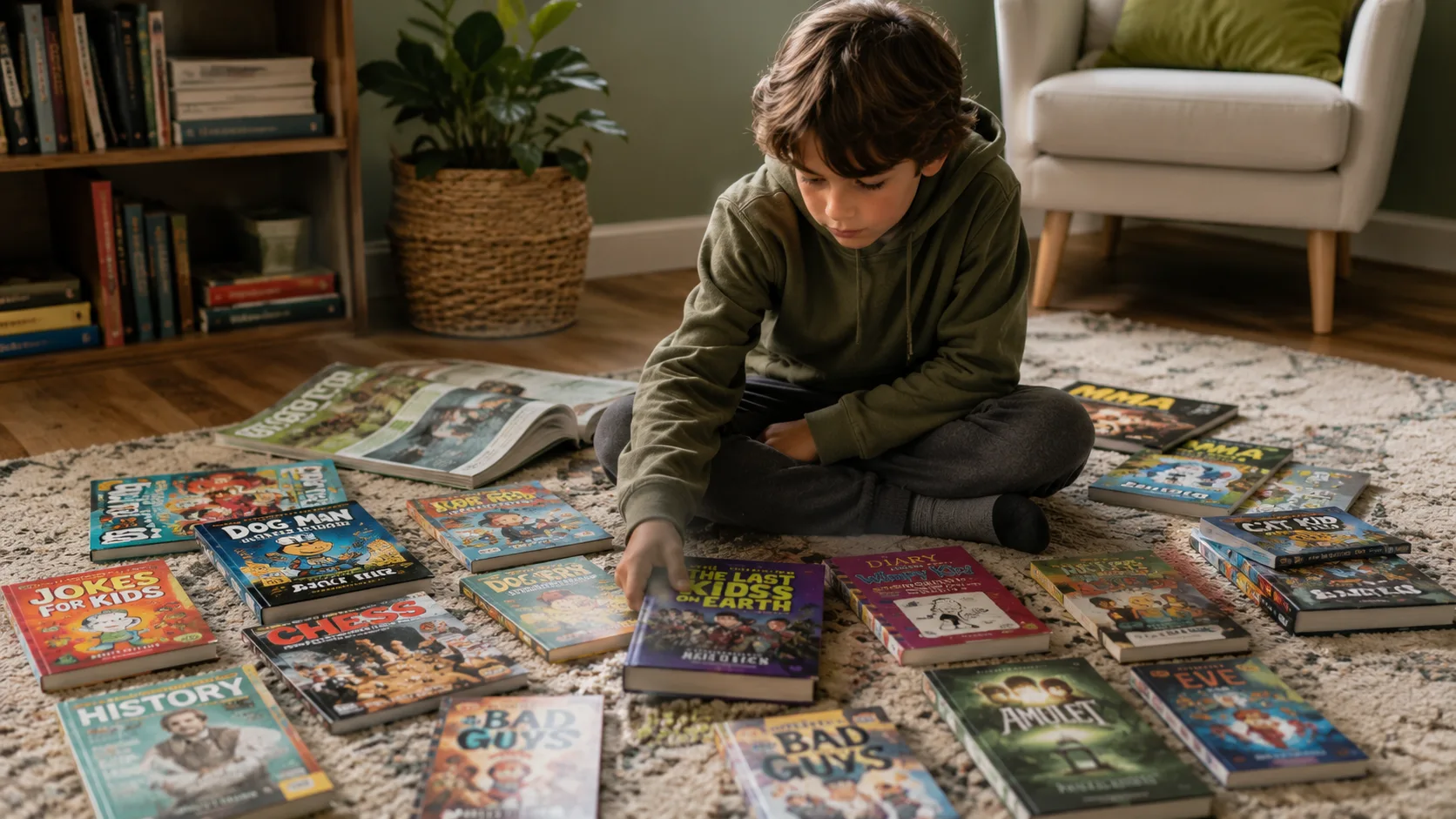
Some children who "won't read" will happily devour graphic novels, joke books, fact books, or audiobooks — they have simply been matched to a format that doesn't fit them yet. When children get to choose, they often reach for humour and popular formats schools overlook.3
What it needs: widen what counts. Comics, magazines, recipe cards, and audiobooks build the same vocabulary and stamina that lead, in time, to longer books.
Somewhere, reading got tied to failure, boredom, or conflict — a tense bedtime routine, a comparison to a sibling, a level always slightly too high. The child isn't avoiding books so much as how books make them feel. Interest, once sparked, can be rebuilt.6
What it needs: rebuild the association with low-stakes, genuinely enjoyable experiences. This is where humour and novelty do real work — laughter turns a test back into a treat.
Decades of work on motivation point the same way: people sustain effort on things they find interesting and feel they chose. In reading specifically, engagement and choice are repeatedly linked to how much — and how willingly — children read.12 It's a strong reason to compete with the "no" by handing back control rather than tightening it.
Most advice you'll find online stops at "make reading fun." That's fine for a bored child, and exactly the wrong move for a child fighting a skill barrier. Naming the cause first is what turns generic encouragement into something that actually helps.
What to do this week — a calm, practical reset
You don't need a programme. You need to lower the temperature and change a few defaults. Start here.
Call a ceasefire
For a week, stop requiring reading and stop the daily negotiation. The power struggle is often half the problem, and it can't ease while it's still a battle.
Offer real choice
Take them to the library or a shelf and let them pick anything — yes, the silly one. Choice isn't a reward you grant; it's the thing that rebuilds ownership.
Lower the level and widen the format
Easier books, comics, joke books, audiobooks. Make the on-ramp gentle enough that success is almost guaranteed.
Read near them, not at them
Sit beside them with your own book, or read the first few pages aloud and stop at a cliff-hanger. Pressure-free company beats instruction.
Find the funny
A child who's laughing has forgotten to resist. Humour is one of the most reliable ways back in for a child whose refusal is about boredom or bad associations.
Protect a small, predictable routine
Ten low-pressure minutes at the same time each day rebuilds the habit faster than an occasional long session.
One idea that takes the pressure off straight away: widen what you count as reading. Volume matters more than format — the children who read the most build vocabulary and fluency fastest, whatever they're reading.5
| Format | Counts as reading? | Why |
|---|---|---|
| Comics & graphic novels | Yes | Real text, real vocabulary, strong engagement — a proven on-ramp. |
| Joke & fact books | Yes | Short, funny, low-stakes — ideal for boredom or bad associations. |
| Audiobooks (alongside print) | Helps | Builds vocabulary and comprehension; pairs well with print for skill-barrier kids. |
| Magazines, recipe cards, game guides | Yes | Reading with a real purpose the child actually cares about. |
| Re-reading the same favourite | Yes | Repetition builds fluency and confidence — let them. |
Sometimes the way back in is a book they can't take seriously
For a child whose refusal is rooted in boredom or a bad association, the most effective first book is often the least "educational" one — the joke book, the comic, the story so funny they read it under the covers with a torch. Laughter is disarming. It quietly proves to a resistant child that reading is not the chore they had decided it was.
That's also why a personalised funny book can be such a low-pressure entry point: when the child is the star of the joke — the hero of a silly, surprising story with their own name in it — the book stops feeling like homework and starts feeling like something made for them.
A personalised story where your child is the hero
A humour-first storybook starring your child by name — a low-stakes, no-pressure way to help a reluctant reader rediscover that reading can be fun. Best suited to refusal that's about boredom or a bad association, not a decoding difficulty.
See the personalised prank book →To be honest about it: a funny book will not fix a genuine skill barrier — a child who struggles to decode still needs support and possibly an assessment. But for the very common child whose "no" is really about boredom or feeling pushed, a book they can laugh at is one of the gentlest ways to turn reading back into something they want to do.
When reading refusal is a signal to get help
Most reading refusal is ordinary and resolves with the resets above. Sometimes, though, it points to something that benefits from a professional eye — and reaching out early is the fastest route to the right support.
- Persistent, effortful struggle sounding out words well beyond what's typical for their age.
- Signs sometimes associated with dyslexia — trouble connecting letters and sounds, frequent reversals beyond the early years, or avoiding reading aloud at all costs. Only a qualified professional can assess this.
- Squinting, headaches, or losing their place in a way that hints at an undetected vision issue.
- Avoidance paired with real distress, anxiety, or a sharp drop in confidence.
This article is general guidance for parents, not a diagnosis. A professional can tell you what your specific child needs.
The bottom line when your child refuses to read
When your child refuses to read, treat the "no" as information, not a final answer. Work out which of the four causes is in play — skill, autonomy, format, or association — and match your response to it. Lower the pressure, hand back genuine choice, widen what counts as reading, and lean on humour to rebuild a good association. For most children, refusal is a phase that ends the moment the right book — often a funny, low-stakes one — reminds them that reading was never the enemy.