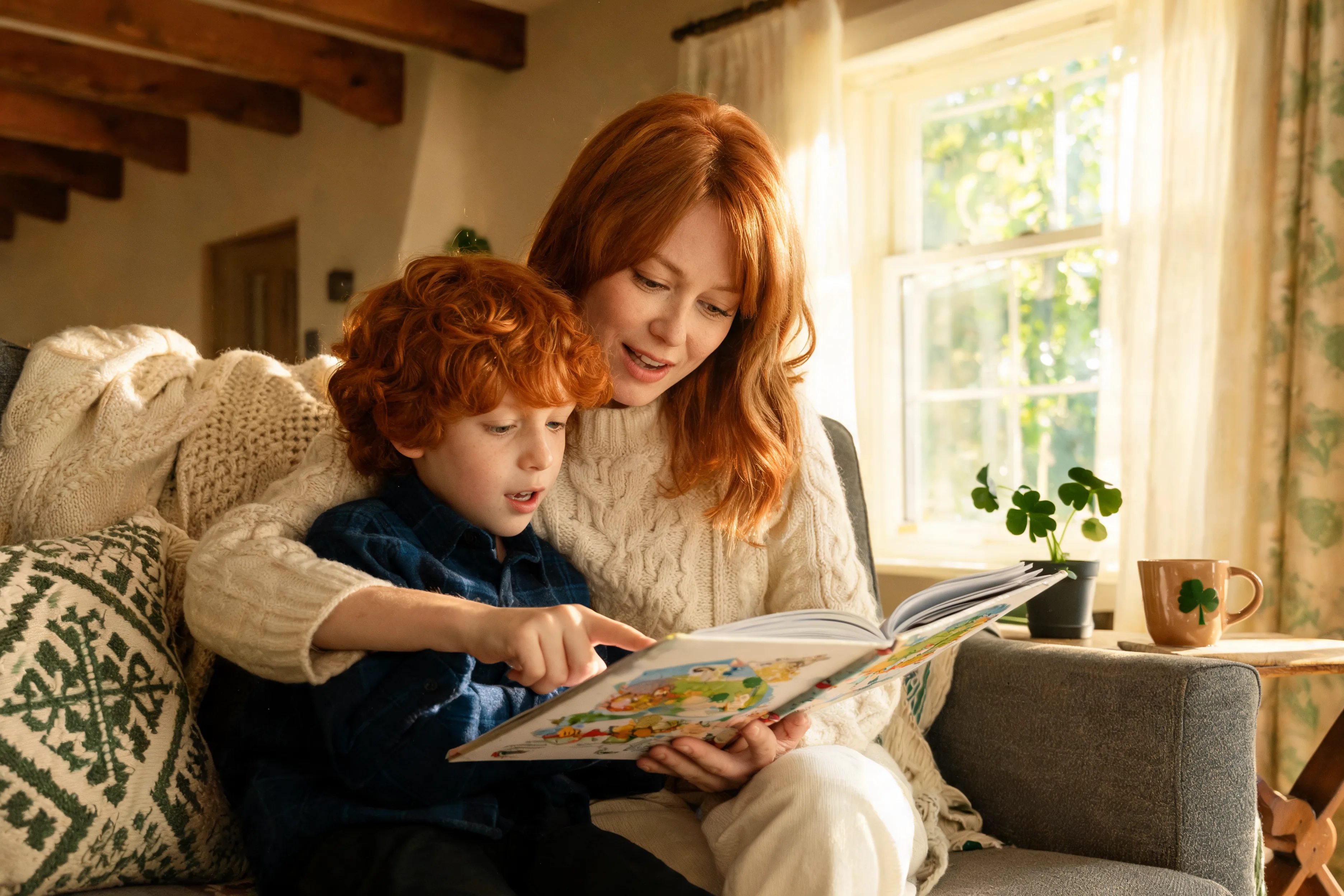
What Is Dialogic Reading? A Parent’s Simple Guide
You do not need worksheets, flashcards, or a special book to make storytime more interactive. Dialogic reading is a structured way to invite a child into the story instead of asking them to listen silently.


Most adults read a picture book by doing almost all the talking. Dialogic reading deliberately shifts some of that work to the child. The adult prompts, listens, expands what the child says, and gives the child repeated chances to describe, predict, remember, and connect ideas.
Dialogic reading is an interactive way to share a book in which the child does more of the talking and storytelling. Evidence supports it as a useful oral-language practice, especially when adults prompt, listen, expand, and keep the exchange enjoyable rather than turning it into a quiz.
What dialogic reading actually means
The U.S. Department of Education’s What Works Clearinghouse describes dialogic reading as an interactive shared-picture-book practice in which the adult and child gradually switch roles: the child becomes more of the storyteller while the adult acts as an active listener and questioner.1 That definition matters because dialogic reading is not simply “asking lots of questions.” The goal is a real back-and-forth exchange.
A practical cycle is simple: prompt, listen, expand, return. Prompt the child about something on the page. Listen long enough for an answer. Expand the answer with one useful detail or a slightly richer sentence. Then return the turn to the child so the conversation continues. If a child says, “Dog running,” an adult might respond, “Yes, the muddy dog is running home. Where do you think he is going?”
What the evidence says—and what it does not
Dialogic reading has a meaningful evidence base, but it is important not to oversell it. The What Works Clearinghouse review found positive effects on oral language in the early-childhood evidence it reviewed, while finding no discernible effects on phonological processing.1 In other words, it is reasonable to use dialogic reading as a language-rich shared-reading practice; it should not be marketed as a complete method for teaching every reading skill.
The broader shared-reading literature points in the same direction. A 2020 meta-analysis of 19 randomized controlled trials involving 2,594 children aged roughly 1–6 found small average effects of book-sharing interventions on expressive and receptive language, and a much larger effect on caregiver book-sharing competence.2 A separate meta-analysis of 38 studies involving 2,455 children found that dialogic reading style moderated word-learning outcomes during shared storybook reading.3
That evidence is strongest as support for language interaction around books, not for claims such as “dialogic reading will make a child an early reader” or “it prevents reading disorders.”
How to do dialogic reading without making storytime feel like a quiz
Start with the picture, not a test
Instead of “What color is this?” every page, ask something the child can genuinely contribute to: “What do you notice?” “What is happening here?” or “Which part looks funny?”
Wait longer than feels natural
Adults often answer their own questions too quickly. A few quiet seconds gives a child time to formulate an idea. If there is no answer, model one and keep moving. The interaction should stay warm, not become a performance requirement.
Expand, do not grade
If the child says “bird,” you can say, “Yes, a tiny yellow bird is sitting on the fence.” You have added vocabulary and grammar without telling the child that the first answer was insufficient.
Ask different kinds of questions
Mix concrete prompts with prediction and connection: “What is that?” “What happened before this?” “What might happen next?” “Have we ever seen something like that?” The exact mix should fit the child’s age and language level.
Follow the child’s interest
If the child wants to talk about one illustration for three minutes, that is not a failed reading session. The American Academy of Pediatrics emphasizes developmentally appropriate, mutually enjoyable, language-rich engagement around books.4 The conversation is part of the point.
What dialogic reading looks like by age
With a baby, “dialogic” can be as simple as naming what the baby looks at, copying a sound, pausing, and responding to a gesture. With a toddler, it can mean pointing, naming, filling in a repeated phrase, or choosing between two possibilities. With a preschooler, prediction, explanation, and retelling become more realistic. School-age children can discuss motives, clues, unfamiliar words, and connections to other stories.
The technique should become less scripted as the conversation becomes more natural. A child who is already volunteering ideas does not need an adult to interrupt every page with a prepared prompt.
Common mistakes
The first mistake is asking too many closed questions. A rapid sequence of “What is this? What color? How many?” can feel like a test. The second is correcting every imperfect answer. The third is prioritizing completion over conversation. You do not need to finish the book for the reading session to be worthwhile.
Finally, do not confuse dialogic reading with decoding instruction. Talking deeply about a story can support oral language and comprehension, but children who need explicit help learning letter-sound relationships or decoding need appropriate reading instruction too.
A five-minute version for busy nights
Pick one short picture book. On three pages, pause once. Ask one open prompt. Expand one answer. At the end, ask the child to name a favorite part. That is enough to make the reading more interactive without turning bedtime into a lesson plan.
Make any picture book more conversational
The useful part is not a special format—it is the back-and-forth. If your child enjoys stories built around their own name and appearance, you can use the same dialogic-reading approach with a personalized Stattner storybook.
Explore personalized storybooks →The best dialogic reading feels like a conversation, not a test.
References
Selected research and evidence-informed sources. Each source below links to the publisher, DOI, PubMed, or authoritative organization used for verification.
- What Works Clearinghouse, U.S. Department of Education. Dialogic Reading evidence snapshot. The review reports positive effects on oral language in the early-childhood evidence base and no discernible effects on phonological processing. Verify source ↗
- Dowdall, N., Melendez-Torres, G. J., Murray, L., Gardner, F., Hartford, L., & Cooper, P. J. (2020). Shared Picture Book Reading Interventions for Child Language Development: A Systematic Review and Meta-Analysis. Child Development, 91(2), e383–e399. DOI: 10.1111/cdev.13225. Verify source ↗
- Flack, Z. M., Field, A. P., & Horst, J. S. (2018). The effects of shared storybook reading on word learning: A meta-analysis. Developmental Psychology, 54(7), 1334–1346. DOI: 10.1037/dev0000512. Verify source ↗
- Klass, P., Mendelsohn, A. L., Hutton, J. S., et al. (2024). Literacy Promotion: An Essential Component of Primary Care Pediatric Practice: Technical Report. Pediatrics, 154(6), e2024069091. DOI: 10.1542/peds.2024-069091. Verify source ↗
What Is Dialogic Reading? A Parent’s Simple Guide: FAQ
Is dialogic reading the same as reading aloud?
No. Reading aloud can be mostly one-way; dialogic reading deliberately creates back-and-forth conversation around the book. You can combine both. Read parts of the text normally, then pause where a picture, idea, prediction, or connection invites the child into the story.
What age is dialogic reading for?
It can be adapted from infancy through the early school years. For babies it may look like pointing, naming, pausing, and responding to sounds or gestures. Older children can predict, explain, retell, and make connections.
Do I need to ask a question on every page?
No. Too many prompts can make reading feel like a test. A few genuine pauses are enough. Follow the child’s interest and keep the story moving when they want to listen.
Does dialogic reading teach children to decode words?
Not by itself. The evidence is strongest for oral-language interaction. Decoding and phonics require their own appropriate instruction.
Can I use dialogic reading with a personalized book?
Yes. The technique can be used with any picture book that gives you something meaningful to discuss. Personal details can create natural conversation prompts, but the same prompt-listen-expand pattern works with ordinary storybooks too.