Should Kids Choose Their Own Books? What Evidence Says
“Let them choose” is common reading advice. It is sensible, but the evidence deserves precision. Recent experimental work shows that choice itself can raise reading enjoyment in young adults; pediatric guidance also encourages child choice. Direct experimental evidence isolating choice in children is smaller and less definitive.


Book choice is not the same as abandoning guidance. A child can have meaningful autonomy inside a carefully selected set of books that are safe, accessible, and realistically readable.
Yes—give children meaningful book choice, with support. Pediatric guidance encourages it, and experimental research in young adults shows that choice can increase reading enjoyment. But direct child evidence isolating choice is more limited, so treat choice as a useful motivation tool rather than a guaranteed fix.
What recent experimental research found
A 2026 Quarterly Journal of Experimental Psychology paper experimentally manipulated book and genre choice. Across two studies, participants enjoyed reading more when they were allowed to choose and were willing to pay more for chosen books.1
There is an important limitation for a parenting article: those experiments used young adults, not children. So they support the psychological mechanism that choice can increase subjective value; they should not be presented as direct proof that every child will read more when given unrestricted choice.
What pediatric guidance says about children
HealthyChildren.org recommends letting children choose the book, even when that means hearing the same book repeatedly.2 That advice fits a low-pressure reading environment: the child has a genuine role in deciding what the reading experience will be.
The broader context matters too. The National Literacy Trust’s 2026 UK survey found that 36.1% of children and young people aged 5–18 said they enjoyed reading in their free time, an improvement from 2025 but still part of a longer-term decline.3 That survey does not prove choice causes enjoyment. It does show why motivation and voluntary reading remain important problems to solve.
The case for bounded choice
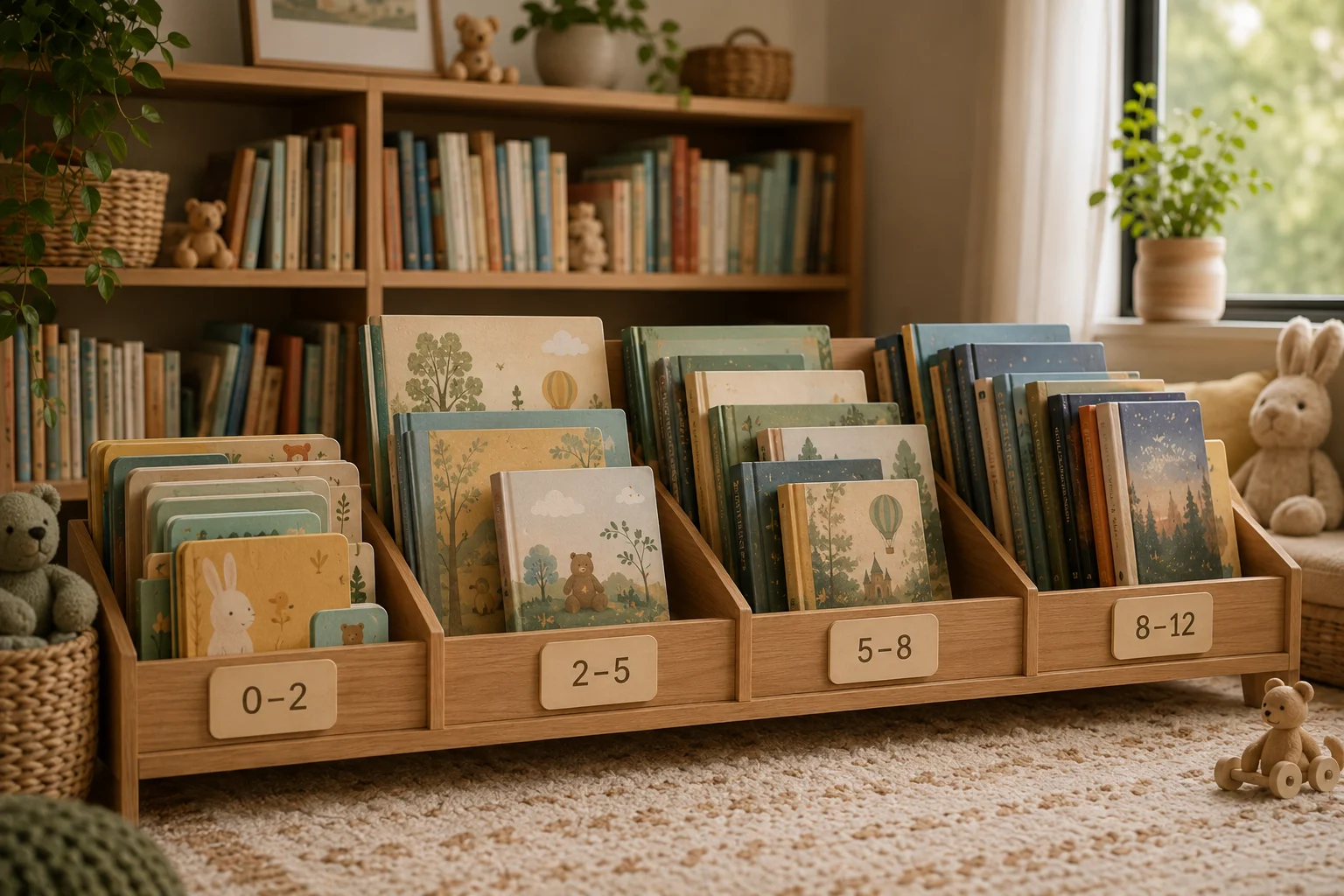
“Choose anything in the entire library” can overwhelm a young child. “Do you want the dinosaur book, the joke book, or the mystery?” still offers real autonomy.
Bounded choice lets an adult control constraints that matter—age appropriateness, availability, difficulty, bedtime length—while the child controls the final selection.
Choice is especially useful when reading has become a power struggle
If a child already feels that reading is something adults impose, making every decision for them can reinforce that feeling. Offer control over the part that is safe to control: which book, where to read, who reads first, whether to stop after one chapter, or whether tonight’s reading is fiction or nonfiction.
The goal is not to manipulate the child into reading. It is to remove unnecessary control from an activity you want them to eventually choose for themselves.
When choice is not enough
A child can choose a book and still struggle because the text is too difficult. They can love the subject and still find decoding exhausting. They can choose freely and still have no interest in reading after a long day.
Choice is a motivation tool, not a diagnosis or a reading intervention. Persistent difficulty sounding out words, unusually effortful reading, or distress around text deserves discussion with the child’s teacher or an appropriate professional rather than simply offering more titles.
How to help a child choose well
Start with interest
Ask what they already like outside books: football, space, animals, jokes, crafts, mysteries, machines, mythology, real-world facts.
Offer multiple formats
Comics, graphic novels, joke books, magazines, nonfiction, picture-heavy books, audiobooks paired with print, and short chapter books can all be legitimate ways into reading.
Keep difficulty in the conversation
For independent reading, the book needs to be readable enough that the child can enjoy it. For read-aloud time, you can choose language above the child’s decoding level because the adult is carrying the print-reading load.
Let a book be abandoned
Adults stop reading books they dislike. Children need some version of that permission too. Finishing every book is not a prerequisite for becoming a reader.
Bottom line
Give children meaningful choices, especially when motivation is fragile, but do not pretend the science says “unlimited choice guarantees more reading.” The strongest practical approach is autonomy with support: a child gets a real decision, and the adult makes it easier to find options that fit.
This article offers general educational guidance, not a diagnosis. If you have persistent concerns about your child’s language, attention, reading development, or learning, discuss them with an appropriate pediatric, educational, or reading professional.
Choice can include a story made around them
If the appeal is ownership, one option can be a personalized printed story. Stattner lets families choose a story, personalize a child’s name and appearance, and preview the result before ordering.
Let them choose a story →Useful choice gives a child ownership without removing helpful adult support.
References
Selected research and evidence-informed sources. Each source below links to the publisher, DOI, PubMed, or authoritative organization used for verification.
- Bains, A., Spaulding, C., Ricketts, J., & Krishnan, S. (2026). Providing choice enhances reading motivation. Quarterly Journal of Experimental Psychology, 79(4), 959–970. DOI: 10.1177/17470218251370916. Note: the two experiments in this paper used young-adult participants, so it should not be presented as direct child evidence. Verify source ↗
- American Academy of Pediatrics / HealthyChildren.org. Tips to Help Your Child Enjoy Reading Aloud. Recommends reading every day, even for a few minutes; letting children choose; and accepting repeated favorites. Verify source ↗
- National Literacy Trust. (2026). Children and young people’s reading in 2026. Annual Literacy Survey report based on 125,375 children and young people aged 5–18 in the UK. Verify source ↗
Should Kids Choose Their Own Books? What Evidence Says: FAQ
Should children always choose what they read?
They should have meaningful choice often, but adults can still set reasonable boundaries. A short menu of age-appropriate, readable options can preserve autonomy without making selection overwhelming.
Does book choice improve reading motivation?
Choice is plausibly helpful and is supported by current guidance, but the evidence needs nuance. A recent experiment found higher enjoyment when readers chose, but its participants were young adults rather than children.
What if my child only chooses comics?
Comics and graphic novels can be legitimate reading choices. If the child is reading willingly, you can build variety gradually rather than removing a format they enjoy.
What if my child chooses books that are too hard?
Keep the interest and change the mode. You can read the harder book aloud together while offering easier books for independent reading.
Should a child be allowed to stop a book halfway through?
Sometimes, yes. Abandoning every challenging text is not ideal, but forcing completion of every disliked leisure book can turn voluntary reading into another compliance task.