

Every parent of a reluctant reader eventually reaches for the sticker chart — a reward for every book finished. The reading happens for a week or two, and then, the moment the rewards stop, so does the reading.
That's not bad luck. When it comes to reading motivation for kids, rewards are one of the few things research suggests can quietly make things worse rather than better2 — and understanding why points straight to what actually works at home. The short version: motivation that lasts comes from inside a child, and the more we try to buy it from the outside, the more we can crowd out the real thing.
Lasting reading motivation for kids comes from inside, not from rewards. Tangible prizes for reading can backfire by turning a pleasure into a chore. What actually works at home is feeding three intrinsic drivers — autonomy (real choice), competence (the right level of challenge), and relatedness (reading together) — and protecting reading as something enjoyed, not something earned.
What "reading motivation" really means (and why it isn't about rewards)
Psychologists draw a line between two kinds of motivation. Intrinsic motivation is doing something because it's interesting or enjoyable in itself. Extrinsic motivation is doing it to earn a reward or avoid a consequence. Both get children reading in the moment — but only one keeps them reading once you leave the room.
That distinction is the whole game. A child reading to fill a sticker chart is being extrinsically motivated; a child reading because they want to know what happens next is being intrinsically motivated. The first stops when the stickers do. The second is the thing you're actually trying to build — and, as it turns out, the two can work against each other.
The reward trap: why sticker charts can backfire
It feels logical to reward reading. The problem is well documented: when children are paid or prized for an activity they already enjoy — or that we want them to enjoy — the reward can become the reason, and their underlying interest fades once it's withdrawn. Psychologists call this the overjustification effect, and it has been observed since classic studies in the 1970s.3 A broad review of reward experiments reached a similar conclusion: tangible rewards offered for doing a task tend to undermine intrinsic motivation for it.2
Paying for page counts, prizes for finishing books, or money per chapter can teach a child that reading is work you do for a payout — so when the payout stops, the reading stops too. The risk is highest for the very children you most want to fall in love with books.
The nuance: rewards aren't universally harmful. For a task a child finds genuinely tedious, or as a one-off celebration, they can be fine. The danger is specifically using ongoing rewards to drive an activity you want them to value for its own sake.
So if not rewards, what? The honest answer is to stop trying to push motivation in from the outside and start feeding the things that grow it from the inside.
| At-home approach | Helps or backfires? | Why |
|---|---|---|
| Letting them choose what they read | Helps | Feeds autonomy — the strongest driver of wanting to read. |
| Reading together / being read to | Helps | Feeds connection; reading becomes warm, not a task. |
| Praising effort and noticing progress | Helps | Builds competence and confidence without making reading transactional. |
| Sticker charts / prizes per book | Backfires | Can crowd out intrinsic interest — reading becomes work-for-pay. |
| Paying money per chapter or page | Backfires | Strongest version of the reward trap; hardest to ever withdraw. |
| Screen time earned by reading | Careful | Frames reading as the price of fun — use sparingly, if at all. |
The three things that actually drive reading motivation
Decades of motivation research keep pointing to the same three psychological needs. Meet them, and motivation tends to grow on its own; ignore them, and no reward chart will hold.1 Here's what each looks like for reading at home.
Children read more, and more willingly, when they get to choose what, where, and when. Choice turns reading from something imposed into something owned — and ownership is most of motivation.4
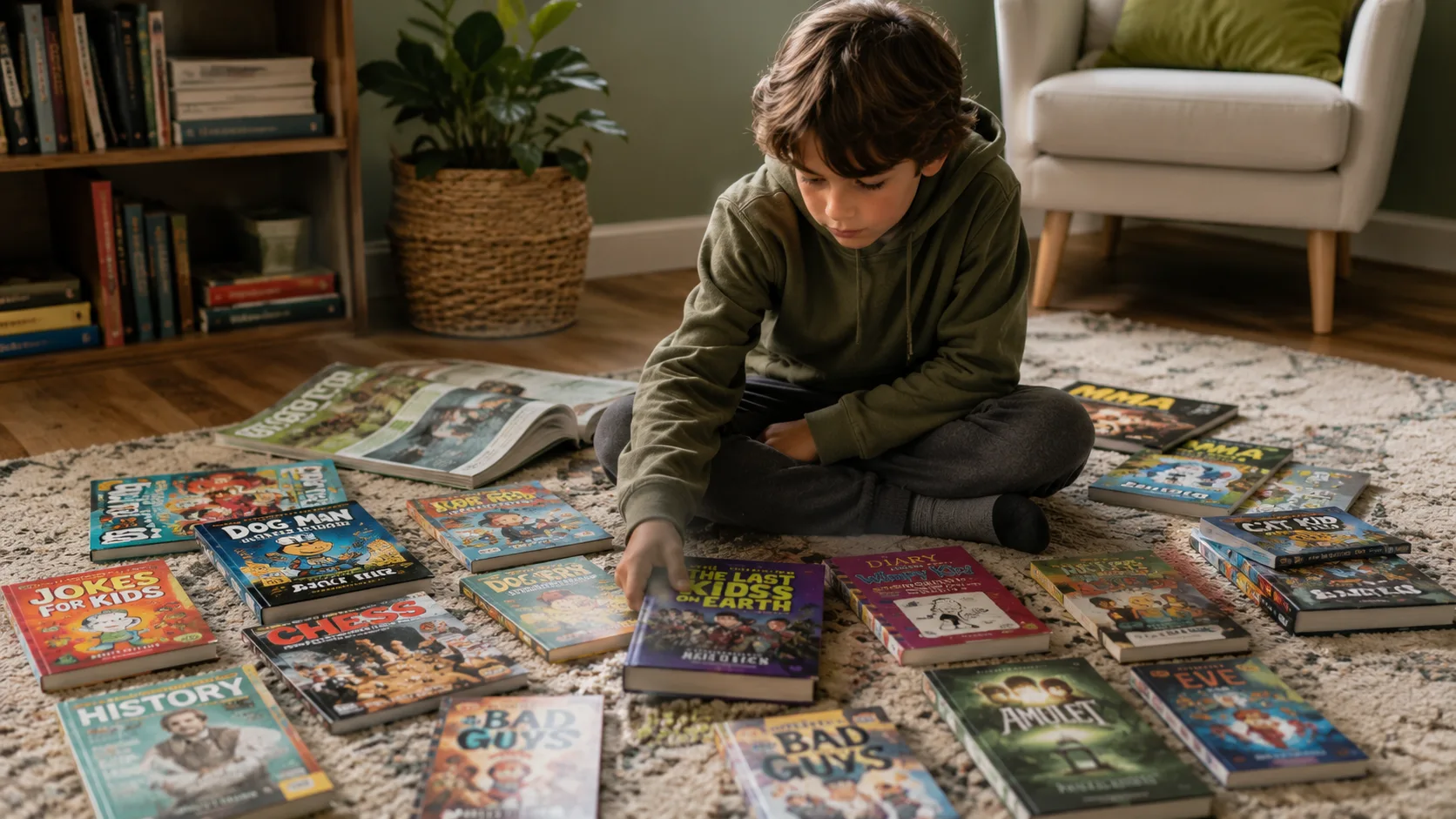
At home: let them pick the book — comics, joke books, fact books all count. Offer a choice of two when a full free-for-all feels too open.
Motivation collapses when reading feels like failing. Children stay motivated when books are at the right level — hard enough to be interesting, easy enough to succeed — and when they can feel themselves getting better.
At home: drop the level if reading is a struggle, celebrate progress over performance, and let them re-read favourites — repetition builds fluency and confidence.
Reading is more motivating when it's social and warm — shared on a sofa, talked about, connected to people a child loves. Being read to, even past the age it "should" stop, keeps the association positive.
At home: read aloud, take turns, talk about the story, and let them see you reading too. Make it a shared moment, not a solo assignment.
Self-determination theory — one of the most studied frameworks in psychology — holds that autonomy, competence, and relatedness are the conditions under which intrinsic motivation grows.1 Applied to reading, engagement and choice are repeatedly linked to how much and how willingly children read.45 It's a strong reason to build the conditions for motivation rather than try to bribe it into being.
What actually works at home
Translate the three drivers into a few simple defaults, and you don't need a reward system at all.
Hand over the choosing
Let your child pick their own books, even the silly ones. A library card is the cheapest motivation tool there is.
Match the book to the child, not the age
Right-level books keep reading feeling possible. If it's a struggle, go easier — confidence first, challenge later.
Keep reading together
Read aloud, take turns, stop at a cliff-hanger. Shared reading keeps the experience warm and connected.
Praise the effort, not the page count
"You really stuck with that tricky bit" builds competence; "three more books for a prize" builds dependence on the prize.
Widen what counts as reading
Comics, audiobooks, magazines, game guides — volume and enjoyment matter more than format.6
Be the model
Children who see the adults around them reading for pleasure absorb that reading is something worth wanting.
Give them books worth being motivated by
Autonomy and interest are easiest to spark when the book itself is genuinely appealing — and for many children, that means funny. Humour lowers the stakes and makes reading feel like a choice they want to make rather than a chore they've been handed.
A personalised funny book stacks two motivators at once: the child gets a story that's clearly theirs (autonomy and connection), and it's built to make them laugh (interest). When a book stars your child by name in a silly, surprising adventure, picking it up stops feeling like homework.
A personalised story your child will actually want to open
A humour-first storybook starring your child by name — it leans on choice, connection, and laughter rather than rewards. Best for children whose low motivation is about interest or boredom, not a decoding difficulty.
See the personalised prank book →Being honest about the limits: a book a child loves supports motivation, but it doesn't teach the mechanics of reading. If the real barrier is skill rather than interest, the answer is support and possibly an assessment — not a better book.
When low reading motivation is a sign of something else
Sometimes what looks like low motivation is really something more specific. If your child isn't just unmotivated but actively refusing — digging in, getting upset, avoiding books entirely — the issue may be a skill barrier or a negative association rather than motivation alone. Our guide on what to do when your child refuses to read walks through how to tell the difference and respond.
- Persistent, effortful struggle decoding words well beyond what's typical for their age.
- Signs sometimes linked to dyslexia — trouble connecting letters and sounds, or avoiding reading aloud entirely. Only a professional can assess this.
- Avoidance paired with real distress, anxiety, or a sharp drop in confidence.
This article is general guidance, not a diagnosis. A teacher or literacy specialist can tell you what your specific child needs.
The bottom line on reading motivation for kids
The most reliable way to build reading motivation for kids isn't to reward reading — it's to make reading feel chosen, achievable, and shared. Protect intrinsic interest instead of paying for page counts, feed autonomy, competence, and relatedness, and give children books they actually want to open. Do that, and you won't need a sticker chart, because the motivation will be coming from the only place it ever really lasts: inside the child.
Motivation you have to pay for disappears the moment you stop paying. The kind that lasts belongs to a child who got to choose, who felt capable, and who found a book worth turning the page for.