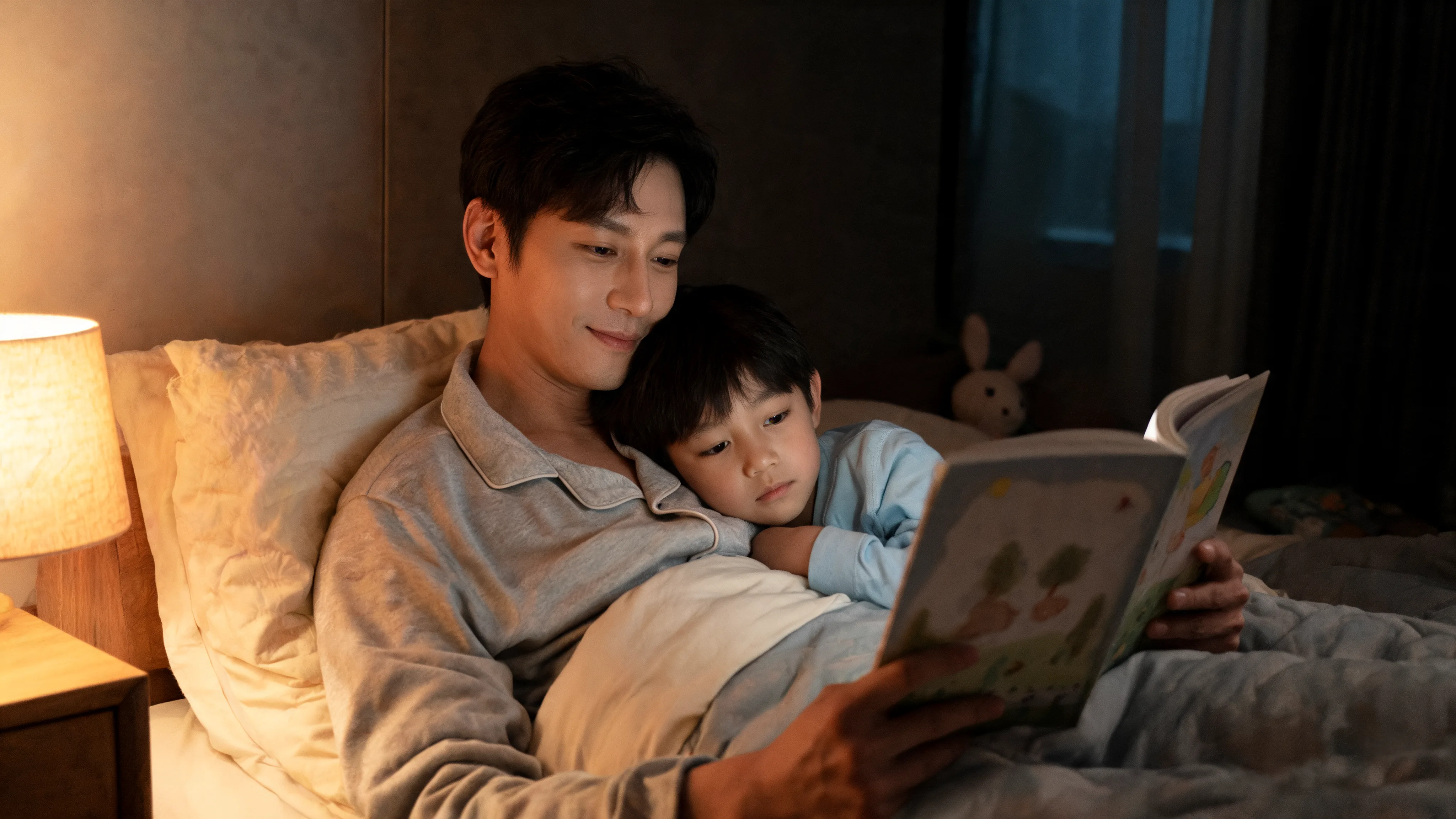


Parents hear it constantly: read to your child. It is one of the most repeated pieces of parenting advice — and one of the most anxiety-producing when life gets busy. The good news is that the research behind the advice is substantial. The more important news is that how you read aloud, and what kind of interaction happens around the book, matters more than whether the book gets finished.
A meta-analysis by Bus, van IJzendoorn, and Pellegrini (1995), examining 33 studies on parent-child book reading, found that joint book reading explains approximately 8 percent of the variance in early reading and language outcomes — a moderate but meaningful effect size that persists even after controlling for socioeconomic status.[1] More recent work by Mol and Bus (2011) extended this finding: print exposure from early childhood through adulthood is associated with reading comprehension, vocabulary, and general knowledge, even when cognitive ability and parental education are accounted for.[4] The evidence is correlational — reading aloud does not cause higher IQ — but the consistency and breadth of the association across decades of research make it one of the most robustly supported activities in early childhood development.
It is worth being clear about what the evidence does and does not say. No single study proves that reading aloud makes a child smarter. What the body of research suggests, across meta-analyses, longitudinal designs, and intervention studies, is that shared book reading tends to create conditions that support development: rich language input, joint attention, emotional closeness, and repeated exposure to narrative structure.[1][4]
Most studies on reading aloud are observational or quasi-experimental. Families who read aloud more often also tend to have more books at home, higher parental education, and more verbal interaction overall. Researchers attempt to control for these confounds statistically, but residual confounding is always possible. The research is best understood as showing that reading aloud is associated with better language and cognitive outcomes — not that it independently and certainly causes them.
What the Research Actually Shows
Before diving into specific domains — vocabulary, cognition, emotion — it helps to understand the shape of the evidence as a whole. The research on reading aloud spans several decades and several methodologies, each with different strengths and limits.
The Bus et al. (1995) meta-analysis remains the most cited synthesis. Across 33 studies and 3,423 participants, joint book reading was moderately associated with language growth (d = 0.59), emergent literacy (d = 0.39), and reading achievement (d = 0.41).[1] These are not enormous effects — but they are consistent and hold across socioeconomic groups.
Sénéchal and LeFevre (2002) followed 168 children from kindergarten through Grade 3 and found that parent reports of early storybook reading predicted children's receptive vocabulary in Grade 1 and reading comprehension in Grade 3, even after controlling for parent education and child cognitive ability.[2] This is not proof of causation, but the temporal pattern — early reading predicting later skills — strengthens the case.
Whitehurst et al. (1988) developed and tested dialogic reading — an interactive style where the adult asks open-ended questions, expands on the child's responses, and lets the child become the storyteller. In a randomised study with 29 children, those in the dialogic reading group showed significantly greater gains in expressive vocabulary.[3] This is one of the few experimental designs in the field, and it suggests that how you read matters.
The picture emerging from the evidence is not "reading aloud is magic." It is: reading aloud tends to provide a context in which language, attention, and emotional connection can develop — and the quality of that interaction shapes how much benefit the child receives.
Vocabulary and Language Development
This is the domain where the evidence is strongest and most consistent. Books contain vocabulary that does not typically appear in everyday conversation. A frequently cited analysis by Hayes and Ahrens (1988) found that children's books contain roughly twice as many rare words per thousand as adult conversation with a child — and more rare words even than prime-time television. When you read aloud, you are giving a child access to a wider lexical world.
Weisleder and Fernald (2013), in a longitudinal study of 29 Spanish-learning toddlers, found that the amount of child-directed speech at 19 months predicted vocabulary size and processing speed at 24 months — and that children who heard more words processed familiar words more quickly, a cognitive efficiency that itself predicted later vocabulary growth.[5] Reading aloud is not the only source of child-directed speech, but it tends to be one of the richest, because books provide structured, varied, and repeated language input.
Importantly, research suggests that reading aloud supports vocabulary learning best when the adult does more than simply read the words on the page. Dickinson and Tabors (2001), in their longitudinal Home-School Study of Language and Literacy Development, found that the quality of talk during book reading — explaining words, connecting story events to the child's own life, asking questions that go beyond the text — was a stronger predictor of kindergarten vocabulary and comprehension than how often books were read.[8]
Farrant and Zubrick (2013), analysing data from a large Australian cohort, found that the number of books in the home and the frequency of parent-child book reading in the first two years of life predicted vocabulary at age 3, even after adjusting for maternal education and family income.[9] The association was strongest when book reading started early and continued consistently.
The "rare word" finding is one of the most pedagogically important in the read-aloud literature. Adult speech to a child tends to be simplified, repetitive, and focused on the immediate context. Books provide vocabulary about distant times, places, and feelings — words such as "enormous," "curious," "brave," "whispered," "journey" — that a child may rarely hear in everyday conversation. This lexical diversity appears to drive much of the vocabulary advantage associated with reading aloud.
Cognitive and Emotional Benefits
Beyond vocabulary, reading aloud has been studied for its associations with broader cognitive and social-emotional development. The mechanisms are less direct — language mediates much of the effect — but the patterns are worth understanding.
Hutton et al. (2015), using functional MRI with 19 preschool-aged children, found that greater home reading exposure — measured by a validated parent-report scale — was associated with greater activation in left-hemisphere brain regions that support semantic processing and mental imagery during a story-listening task.[6] This is a small neuroscientific study, not a definitive causal claim, but it offers a plausible neural correlate: children who are read to more often appear to engage narrative-processing brain networks more robustly.
On the social-emotional side, Mendelsohn et al. (2018), analysing data from the Video Interaction Project — a parenting intervention that uses video feedback to promote reading aloud and play — found that increased parent-child reading and play at 6 months was associated with reduced hyperactivity and improved social-emotional scores at 3 years.[7] The study cannot isolate reading aloud from the broader parenting intervention, but it suggests that shared reading may be one pathway through which early parent-child interaction supports emotional regulation.
Shared reading also offers a context for what developmental psychologists call mental state talk — conversations about what characters think, feel, believe, and want. A growing body of research (e.g., Symons et al., 2005; Adrian et al., 2005) suggests that parent-child talk about mental states during book reading is associated with children's later theory of mind and social understanding. When you pause to ask "Why do you think she is sad?" or "What do you think he will do next?", you are not just testing comprehension — you may be supporting the child's ability to understand other minds.
The emotional closeness of reading aloud also matters. Bus and van IJzendoorn (1995) noted in their meta-analysis that joint book reading was associated not only with language outcomes but also with attachment security, particularly when the reading interaction was warm and responsive.[1] A child who associates books with a parent's lap, attention, and voice is building an emotional foundation for reading that may persist even when the books themselves become more challenging.
Practical Application for Parents
The research points toward several practices that tend to be more effective than simply reading words from beginning to end. The distinction between reading to a child and reading with a child is one of the most important in the evidence base.
Make it a ritual, not a task
Reading aloud works best when it feels like connection, not obligation. Even ten minutes a day, at a predictable time, can become something the child looks forward to. Consistency matters more than duration.
Read above the child's independent level
When you read aloud, you can choose books with vocabulary and themes the child cannot yet access alone. This is one of the key advantages of read-aloud over independent reading: it expands the zone of exposure.
Use your voice
Expression, pacing, and different voices for characters are not just entertainment — they signal meaning, emotion, and story structure. Research on prosody suggests that expressive reading helps children parse sentences and understand narrative tone.
Pause and invite
Stop after a dramatic moment. Ask what the child thinks will happen. Let them point, comment, or turn back to a favourite page. The interaction — not the page count — is where the developmental benefit tends to live.
Do not turn every book into a quiz
Asking occasional questions supports comprehension; turning every page into a test can make reading feel like school. Most of the time, let the story be a story.
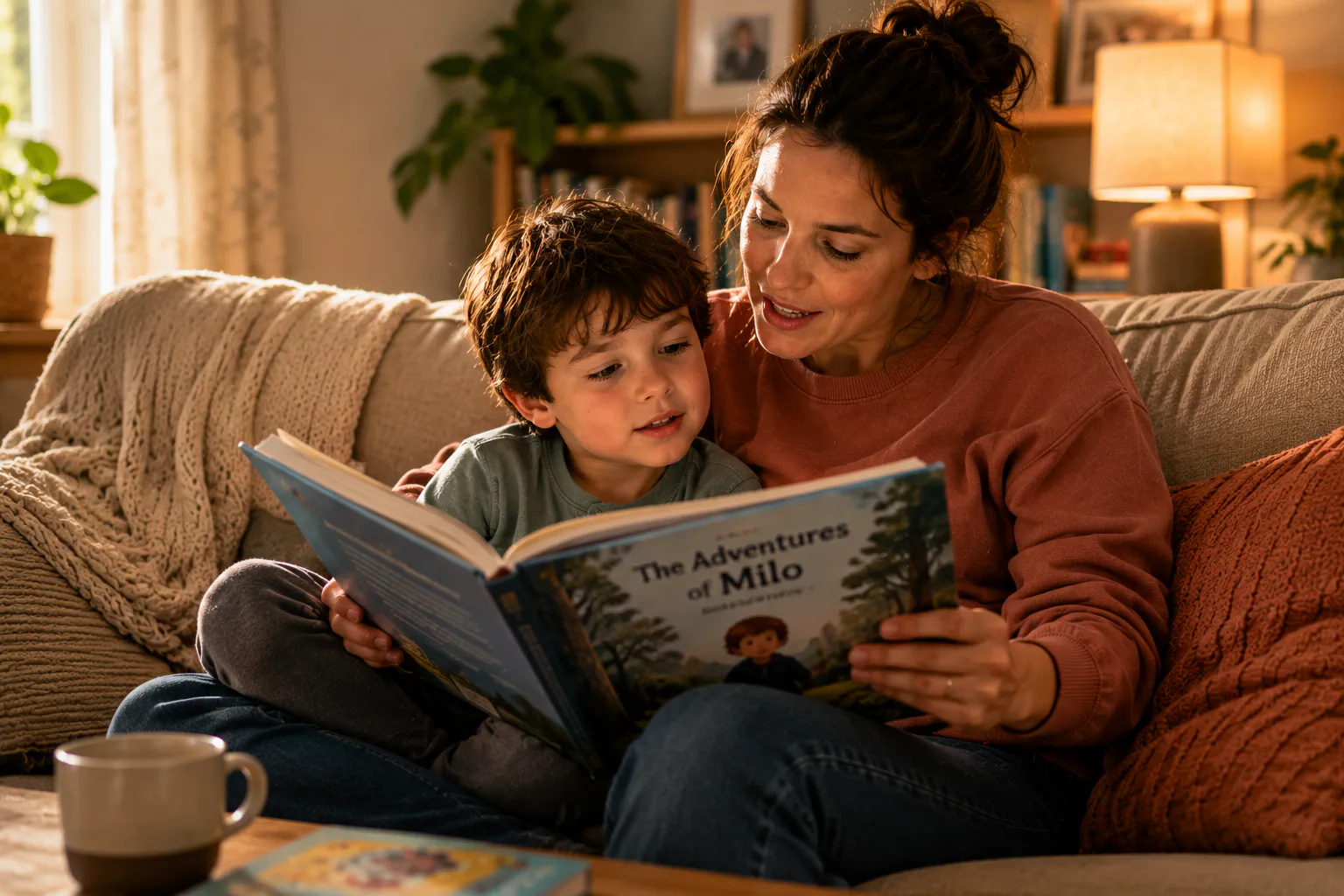
Making Read-Aloud Time Even More Engaging
One of the most reliable research findings in the reading motivation literature is that personal relevance increases engagement. When a child sees themselves in a story — their name, their interests, their world — the book becomes harder to ignore. This is not magic, and it is not a substitute for the interactive practices described above. But for many families, a personalised book can be the book a child asks to hear again.
Self-reference research suggests that material connected to the self is processed more deeply in memory. In the context of read-aloud, that can mean a child who is more attentive, who points at their own name on the page, and who feels that this story belongs to them — not to the adult who chose it.[1]
A personalised children's book can make read-aloud time feel like it was made just for them.
Our personalised children's book is designed for families who want read-aloud to feel personal — not generic. The child is the main character. Their name, their world, their adventure. It works best as a shared reading experience: a book that sits on the couch between you, not a screen that isolates.
Explore the personalised bookLimitations: What the Research Cannot Tell You
Good science is honest about what it does not know. The read-aloud literature is no exception.
| Claim | What the evidence says | Caveat |
|---|---|---|
| Reading aloud improves IQ | No direct evidence | Associations between reading aloud and cognitive outcomes are small and likely mediated by language. No study isolates reading aloud as a direct cause of higher general intelligence. |
| Reading aloud guarantees school readiness | Partial support | Reading aloud is associated with better language and pre-literacy skills, but it is one factor among many. Parenting warmth, socioeconomic resources, preschool quality, and genetic factors all contribute. |
| More minutes always means more benefit | Not supported | Research on quality versus quantity suggests that interaction quality during reading matters more than total minutes. Forced, stressful, or distracted reading is unlikely to confer the same benefits as engaged, warm shared reading.[8] |
| Digital read-aloud is equivalent to in-person | Not equivalent | Some studies suggest that audio and video books can support vocabulary when used thoughtfully, but they do not replicate the interactive, responsive, emotionally connected experience of a caregiver reading aloud. The social and emotional dimensions are harder to digitise. |
| If you did not start early, it does not matter | False | Starting early is beneficial, but reading aloud supports development at every age. There is no window that closes. Starting at age 4, 6, or 8 is still valuable. |
Reading aloud is not a diagnostic tool, but it can reveal patterns worth noting. If a child consistently shows no interest in being read to, cannot sit and attend to a short picture book by age 2–3, shows no recognition of familiar book characters or routines, or seems unable to follow a simple story when read aloud by preschool age, consider a conversation with a paediatrician or speech-language pathologist. These are not definitive red flags — development varies widely — but they can be worth exploring if combined with other concerns about language, hearing, or attention.
Conclusion
The research on reading aloud is not a story about guaranteed outcomes. It is a story about probability: children who are read to regularly tend to hear more words, encounter richer language, develop stronger narrative understanding, and associate books with warmth and attention. These are not small things. They are the foundations on which later reading, learning, and connection are built — but they are foundations, not certainties.
A parent who reads aloud five minutes a day with genuine attention may be doing more for their child's development than a parent who reads thirty minutes with their mind elsewhere. The quality of the interaction — the questions asked, the laughter shared, the voices tried, the patience offered — appears, in study after study, to be the active ingredient.
Reading aloud benefits child development most when it is not treated as an intervention. It works best as a ritual: imperfect, human, sometimes interrupted, but consistent. A book. A lap. A voice. A story that someone chose to share.
That is what the research — across decades, across countries, across methods — keeps pointing toward.