
How to Get Boys to Read
If your son says he "hates reading," you're far from alone—and the answer isn't more pressure. Here's what the research says actually works.
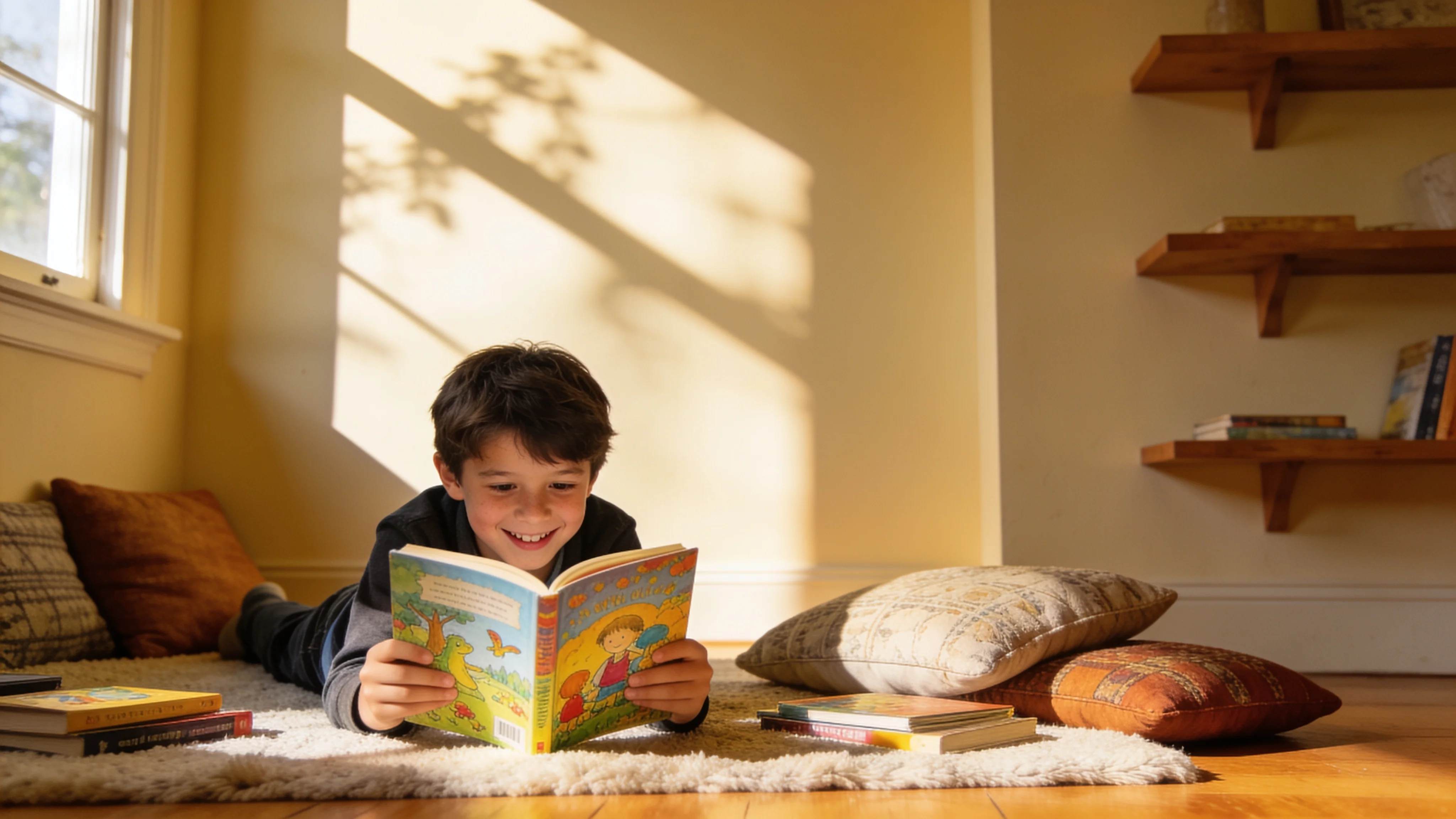
Ask a room of parents who's worried about a son who won't read, and a lot of hands go up. It's one of the most common questions in any conversation about kids and books: how do I get my boy to read? Before the how, though, it helps to clear up the why—because the most popular explanation is also the most damaging one. The idea that boys are simply "not readers" isn't just discouraging; it's mostly wrong, and believing it can quietly make the problem worse.
There's a real, measurable pattern here. But understanding what's actually behind it changes everything about how you respond. Let's look at the honest truth about boys and reading, why so many boys check out, and the specific moves that tend to bring them back.
First, the honest truth about boys and reading
The gap is real. Across many countries and for many years, girls have, on average, outperformed boys on reading assessments, and boys are more likely to report that they don't enjoy reading.1 If your son is struggling or resisting, you're seeing a pattern that shows up at large scale—you're not imagining it.
But here's the part that matters: that gap is an average across groups, not a verdict on any individual boy, and the evidence points to engagement, motivation, reading identity, and the match between boys and the books on offer—not innate ability—as the real drivers.2,3 There's no "reading gene" girls have and boys don't. Plenty of boys are voracious readers, and most reluctant boys read happily the moment they find material that actually fits them. The danger is treating "boys don't read" as a fixed fact: a boy who absorbs that message has a ready-made excuse to opt out, and the label becomes self-fulfilling.
Why so many boys check out of reading
If it's not ability, what is it? Four recurring reasons explain most reluctant boys—and notice that every one of them is fixable.
The books don't match the boy
Much of what's offered at school skews toward narrative fiction, while many boys gravitate to humor, action, and non-fiction about real things. When kids were asked what they wanted to read, their top picks were often the hardest to find in class.
Reading is framed as "sit still and be quiet"
For a kid with a lot of energy, "go read silently for 30 minutes" can feel like a punishment. The activity, not the words, becomes the turn-off.
Few male reading role models
If the readers a boy sees most are his mom and his (often female) teacher, reading can start to feel like "not a thing guys do." Kids absorb who does what.
A too-narrow idea of "real reading"
Comics, joke books, game guides, sports stats, how-things-work books—many boys read these eagerly, then get told it "doesn't count," which erases the reading they are doing.
What actually works
The strategy follows directly from the reasons above: stop trying to make your son fit reading, and start making reading fit your son.
-
Follow his real interests—even the weird ones
Dinosaurs, pranks, soccer, snakes, Minecraft, disgusting facts about the human body—whatever lights him up, there's a book for it. Interest is the single most powerful motivator, and it doesn't care whether the topic is "literary."
-
Widen what counts as reading
Comics, graphic novels, non-fiction, magazines, and joke books are all real reading that build real skills. (Here's the case for graphic novels for reluctant readers.) Count it all, out loud.
-
Lean hard into humor
Funny books are one of the most reliable hooks for reluctant boys—it's tough to feel like reading is a chore when you're laughing. (More on why humor makes reading easier.)
-
Show him men who read
Let him catch dad, an uncle, a coach, or an older brother reading—anything, from a novel to the sports page. Seeing reading modeled by men he admires reframes it as something for him, too.
-
Drop the pressure and the comparisons
"Your sister read three chapter books this week" adds shame, and shame kills curiosity. Pushing harder usually backfires (here's why pressure makes kids hate reading). Invite; don't force.
-
Make him the hero of the story
Ownership is a powerful motivator. A book a boy feels is his—where he's the main character—carries none of the "assignment" baggage of school reading and gives him a reason to open it on his own.
The humor-plus-ownership shortcut
If you combine the two levers that work best for reluctant boys—humor and ownership—you get something close to irresistible: a funny book that's actually about him. That's a book a boy reaches for without being asked, which is the entire goal.
Make your son the star of his own funny story
The Stattner personalized prank book turns your child into the hero of a hilarious adventure—his name, his jokes, his story. It hits the two things reluctant boys respond to most: it's genuinely funny, and it's unmistakably theirs. Not a reading assignment—a book he actually wants to crack open.
Explore the personalized prank book →So if you've got a son who "hates reading," try swapping the worry for curiosity—about him. What makes him laugh? What is he obsessed with? Start there, count everything he reads, let him see reading as something guys do, and take the pressure off. Boys who "don't read" almost always turn out to be boys who hadn't yet met the right book. Your job isn't to make him a reader by force—it's to help him find it.
Frequently asked questions
Why do boys struggle with reading more than girls?
On average, boys score lower than girls on reading assessments in many countries, but research points to engagement, motivation, reading identity, and the match between available books and boys' interests—rather than innate ability—as the main drivers. The gap is a pattern across groups, not a fixed trait of any individual boy.
Are boys just naturally worse at reading?
No. There's no evidence that boys are inherently incapable readers. The differences seen in averages are heavily shaped by motivation, the texts on offer, role models, and how reading is framed. Plenty of boys are avid readers, and most reluctant boys read enthusiastically once they find material that fits them.
What kind of books do reluctant boys like?
It varies by child, but reluctant boys often connect with humor and gross-out comedy, action and adventure, non-fiction about real things (sports, animals, space, how things work), graphic novels and comics, and series they can binge. The key is following the individual child's genuine interests rather than assuming.
How do I get my son to read without forcing him?
Give him real choice, widen what counts as reading (comics, non-fiction, joke books), lean into humor, let him see men in his life reading, and drop comparisons to siblings or classmates. Pressure tends to backfire; the goal is to make reading feel like something he gets to do, not something he's made to do.
At what age do boys tend to fall behind in reading?
Gaps in reading attitudes and scores often appear in the early-to-middle elementary years and can widen if reading starts to feel like a chore or a source of failure. The earlier you protect a boy's enjoyment of reading—through choice, humor, and the right books—the easier it is to keep him engaged.
References & further reading
- OECD (2015). The ABC of Gender Equality in Education: Aptitude, Behaviour, Confidence. OECD Publishing. (Documents the reading gender gap and its links to motivation and engagement.)
- Smith, M. W., & Wilhelm, J. D. (2002). "Reading Don't Fix No Chevys": Literacy in the Lives of Young Men. Heinemann.
- Worthy, J., Moorman, M., & Turner, M. (1999). What Johnny likes to read is hard to find in school. Reading Research Quarterly, 34(1), 12–27.
- McGeown, S. P., et al. (2012). Gender differences in reading motivation. Journal of Research in Reading.
- U.S. National Assessment of Educational Progress (NAEP), Reading assessments — reported gender differences in reading scores.
Editorial note: sources are cited at a general level to support the points discussed. Verify each citation and confirm it supports the specific claim before publishing. This article describes group-level patterns and is not a judgment about any individual child; it is educational and not a substitute for advice from a teacher or reading specialist.