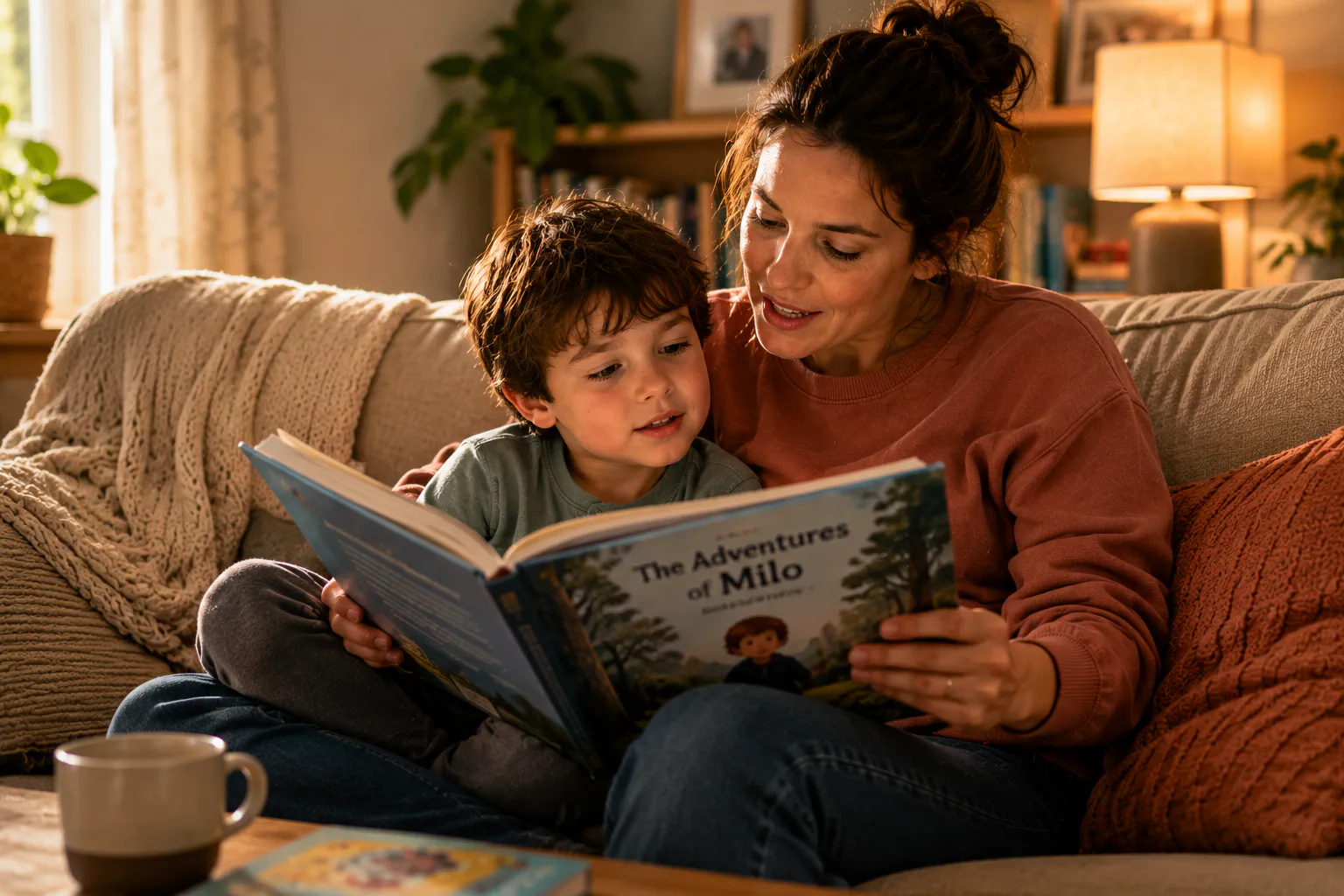
How Often Should You Read to Your Child?
Parents are often told to hit a specific daily reading target. The research and major pediatric guidance support something simpler: read together regularly, make it enjoyable, and aim for a daily habit when you can.


There is a difference between a useful routine and a magic dose. “Read every day” is a practical recommendation found in pediatric and early-childhood guidance. “Exactly 20 minutes or it does not count” is not a universal evidence-based threshold.
Aim for shared reading every day when possible. The American Academy of Pediatrics and other early-childhood organizations recommend regular or daily reading, but there is no universal evidence-based number of minutes every child must reach. A short, warm, interactive session still counts.
The clearest answer: aim for daily, but do not worship the clock
The American Academy of Pediatrics’ 2024 policy statement recommends shared reading beginning at birth and continuing at least through kindergarten. Its “5 R’s” frame reading together as a daily fun family activity.1 HealthyChildren.org tells parents to read every day even if only for a few minutes.2 NAEYC similarly recommends reading aloud at least once each day.3
Those recommendations are about building a reliable, language-rich routine—not proving that every child needs the same number of minutes.
Is there a research-backed minimum number of minutes?
There is no single universal minute threshold in the major guidance above. Families differ in child age, attention, language, schedule, book type, and whether the child is listening or actively discussing the story.
That is why a better target is: make shared reading frequent enough to become normal. Five engaged minutes with a toddler can be a real reading session. A school-age child may happily listen for much longer. Neither experience needs to be stretched to hit an arbitrary number.
Why regular shared reading is worth protecting
A 2020 meta-analysis of 19 randomized controlled trials, involving 2,594 children, found that interventions designed to improve shared picture-book reading produced small average gains in children’s expressive and receptive language and a large improvement in caregivers’ book-sharing competence.4
The finding does not tell us that “X minutes per day causes Y vocabulary increase.” It supports the broader idea that how families share books can be changed, and those interventions can benefit language outcomes on average.
Quality matters alongside frequency
A parent can technically read for 20 minutes while a child is disengaged, or read for six minutes while having a rich conversation about pictures and ideas. Interactive reading—pausing, responding to the child, explaining a word, letting the child predict—can make short sessions language-rich.
That does not mean every reading needs questions. Sometimes a child simply wants to hear the story. Enjoyment is part of sustainability.
A realistic frequency by age
Babies
Very short, frequent book moments are enough. A baby may attend for only a few minutes. Reading can happen after feeding, during floor play, or before sleep.
Toddlers
Daily is a useful goal, but flexibility is essential. Two pages before a toddler runs away still counts as shared reading. Try again later instead of forcing completion.
Preschoolers
A daily picture-book routine often becomes easier because children can follow longer stories and participate more. Repeated favorites are normal.
School-age children
Do not automatically stop reading aloud once a child can read independently. Shared reading can expose them to stories and language above their current independent-reading level while preserving a family routine.
What to do on nights when there is no time
Read one page. Look at one picture and talk about it. Recite a familiar rhyme. Continue the chapter tomorrow. A tiny habit is easier to preserve than an all-or-nothing rule.
If “daily” becomes a source of conflict or guilt, the routine is working against its purpose. Return to something brief and enjoyable enough that both people are willing to repeat it.
What matters more than hitting a streak
Consistency over months matters more than maintaining a perfect calendar. So do access to appealing books, the child’s ability to choose sometimes, and the emotional tone of the interaction. Reading is easier to repeat when it feels like shared time rather than a compliance task.
Bottom line
Aim to share books every day when possible. Let the length expand or shrink with the child and the day. There is strong guidance for frequent shared reading and a meaningful evidence base for interactive book-sharing, but there is no scientific reason to panic because Tuesday’s reading lasted four minutes instead of twenty.
Make the daily book easy to choose
A reading habit is easier when there is a book the child is genuinely eager to open. Stattner creates printed personalized storybooks that families can preview before ordering.
Explore Stattner books →Regular shared reading matters more than winning a stopwatch.
References
Selected research and evidence-informed sources. Each source below links to the publisher, DOI, PubMed, or authoritative organization used for verification.
- Klass, P., et al. (2024). Literacy Promotion: An Essential Component of Primary Care Pediatric Practice: Policy Statement. Pediatrics, 154(6), e2024069090. DOI: 10.1542/peds.2024-069090. Verify source ↗
- American Academy of Pediatrics / HealthyChildren.org. Tips to Help Your Child Enjoy Reading Aloud. Recommends reading every day, even for a few minutes; letting children choose; and accepting repeated favorites. Verify source ↗
- National Association for the Education of Young Children. Everyday Steps to Reading and Writing. Recommends reading aloud at least once daily, repeating favorites, and talking before, during, and after reading. Verify source ↗
- Dowdall, N., Melendez-Torres, G. J., Murray, L., Gardner, F., Hartford, L., & Cooper, P. J. (2020). Shared Picture Book Reading Interventions for Child Language Development: A Systematic Review and Meta-Analysis. Child Development, 91(2), e383–e399. DOI: 10.1111/cdev.13225. Verify source ↗
How Often Should You Read to Your Child?: FAQ
How many minutes a day should I read to my child?
There is no universal evidence-based minute target that fits every child. Major guidance emphasizes regular or daily shared reading. Let the duration fit age, attention, and family life.
Does five minutes of reading count?
Yes. A few engaged minutes can be a meaningful shared-reading session. Short reading is especially normal with babies and toddlers, whose attention may shift quickly.
Should I read every day?
Daily is a useful goal and is recommended by major pediatric and early-childhood guidance. Treat it as a routine to make reading normal, not as a streak that creates guilt.
Should I stop reading aloud when my child can read alone?
No. You can continue reading aloud after independent reading begins. Shared reading remains a way to enjoy more complex stories and spend time together.
Is longer always better?
No. Duration is only one part of the experience. A shorter session with genuine attention and conversation can be more sustainable than forcing a long session.