
Are Graphic Novels Good for Reluctant Readers?
Your child devours graphic novels but won't touch a "real" book—and you're wondering if it counts. The short answer: it counts, and it may be exactly what they need.
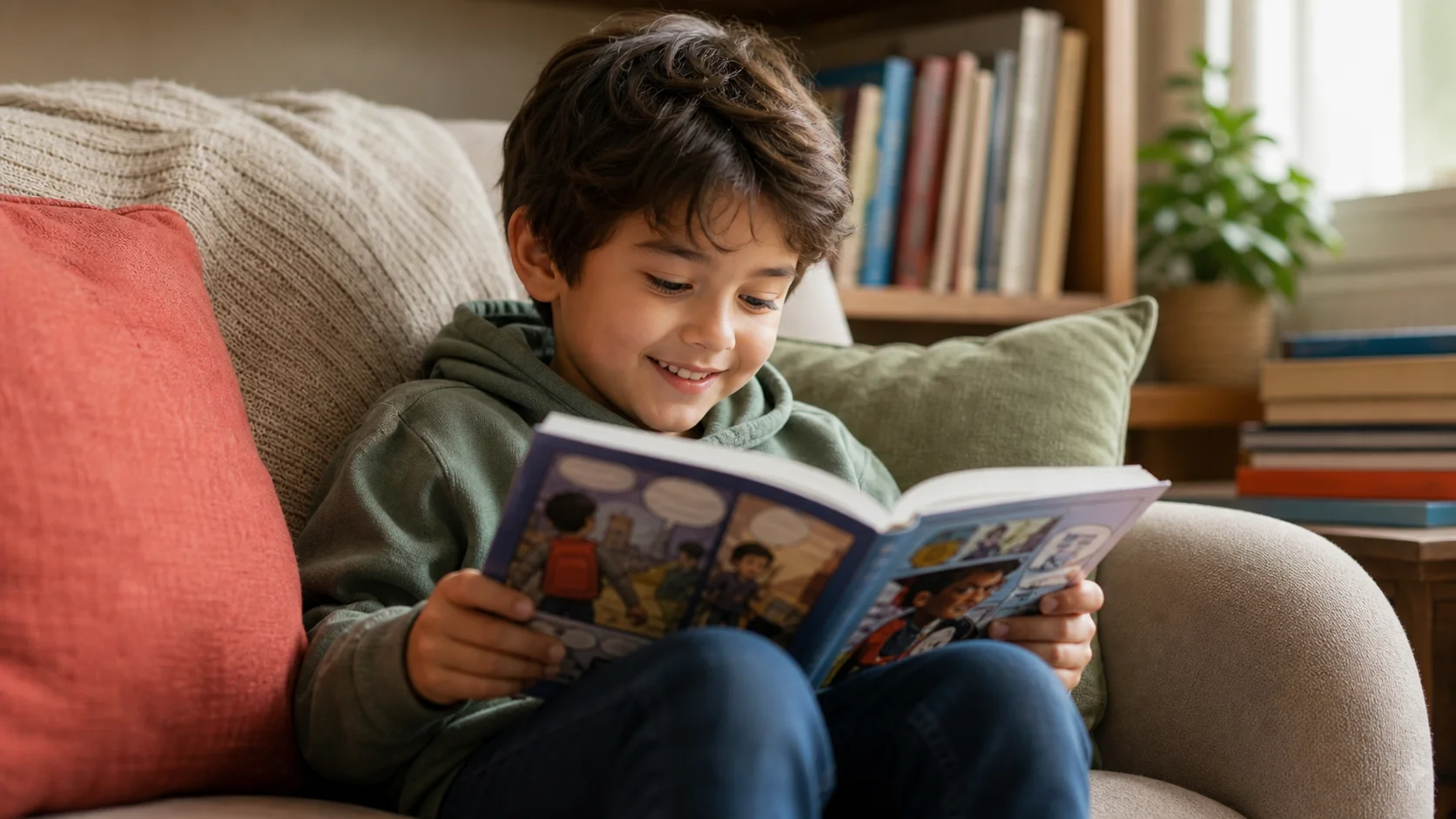
Here's a scene a lot of parents know: your child won't go near a chapter book, but they'll plow through a stack of graphic novels in an afternoon, laughing, re-reading, asking for the next one in the series. And somewhere in the back of your mind, a worried voice asks: does this actually count as reading? It's a fair question—and the honest, research-backed answer is yes. Not only do graphic novels count, but for a reluctant reader they're often the single best on-ramp back to books.
The skepticism is understandable. Graphic novels look easy. They're full of pictures, the text is sparse, and they don't resemble the dense paragraphs we associate with "serious" reading. But that appearance is misleading. Let's unpack why graphic novels work so well for kids who resist reading, tackle the "is it real reading?" worry head-on, and look at how to use them well—including how to gently bridge toward other kinds of books.
Why graphic novels work for reluctant readers
A reluctant reader usually isn't anti-story—they're anti-struggle. Dense text can feel like a wall: too many words, too few rewards, too easy to fail in front of everyone. Graphic novels lower that wall in four specific ways.
They lower the intimidation
Less text per page and lots of white space make a graphic novel feel finishable. A child who freezes at a wall of prose will happily start a page that looks manageable—and starting is half the battle.
The pictures carry meaning
Images give context that supports comprehension. When a child meets an unfamiliar word, the panel often shows what's happening, so they can infer meaning instead of stalling. The visuals scaffold the text.
Kids actually want to read them
Engagement drives volume, and volume drives skill. A child who reads ten graphic novels for fun is practicing far more than one who avoids a single "just-right" prose book. Want-to beats have-to.
They build a reader's identity
Finishing books—any books—changes how a child sees themselves: from "I can't read" to "I'm someone who reads." That identity shift is the foundation everything else is built on.
"But is it real reading?"
This is the worry underneath all the others, so let's take it seriously. The assumption is that pictures do the work and the child gets a free pass. The reality is almost the opposite: reading sequential art asks the brain to do more at once, not less.
To read a graphic novel, a child decodes the written words and interprets the images and figures out what happened in the gap between one panel and the next—a mental move comic theorists call "closure."3 The story doesn't show every moment; the reader fills in the action between panels, tracks who's speaking, reads facial expressions and body language, and follows the plot across the page. That's inference, comprehension, and visual literacy working together—genuinely complex reading, just in a different form.
There's a second, quieter benefit. Graphic novels are also a lifeline for children who find decoding hard—including struggling readers and kids learning English—because the images provide a parallel path to meaning while their text skills catch up.4,5 Far from being a crutch, that support is exactly what lets a struggling reader stay in the story instead of giving up on it.
How to use graphic novels well
Graphic novels do the most good when adults treat them as legitimate reading and use them with a little intention. Five simple moves.
-
Count it as reading—out loud
Drop the "that's not a real book" comments entirely. The judgment adds shame and pressure, which is the fastest way to kill the very interest you want to grow. (More on why pressure makes kids hate reading.)
-
Follow their interest
Let them choose the series, the subject, the silliness. Many of the most beloved graphic novels for kids are also hilarious—and humor is its own powerful hook (here's why humor makes reading easier).
-
Talk about the pictures, too
Ask "how do you think she's feeling here?" or "what happened between these two panels?" You're strengthening inference and visual literacy—and showing that the images are part of the reading, not a distraction from it.
-
Use series to build momentum
A child hooked on book one of a series has a built-in reason to read books two through ten. Momentum, not pressure, is what turns occasional reading into a habit.
-
Build a bridge when they're ready
Offer hybrid illustrated novels (lots of pictures, more text) and graphic adaptations of prose stories as stepping stones. Let the move toward prose be an invitation, never a demand—and don't rush it.
Beyond the bookshelf: humor and ownership
If you step back, the reason graphic novels work comes down to a few ingredients: visuals that make stories inviting, humor that lowers the stakes, and genuine interest that makes a child want to keep going. Those same ingredients can be built into other kinds of books, too—and one of them adds a hook a graphic novel can't: making the child the star of the story.
An illustrated, funny book starring your child
The Stattner personalized prank book pairs the same things that make graphic novels click—pictures, humor, a story kids want to finish—with one more: it's about them. Your child is the hero, the jokes are theirs, and the book is theirs to reach for. It's not homework; it's a book they actually want to open—which, for a reluctant reader, is the whole game.
Explore the personalized prank book →So the next time you watch your child tear through a pile of graphic novels, you can relax. They're decoding, inferring, building vocabulary, and—maybe most important—learning that books are something to enjoy. That's not a shortcut around reading. For a reluctant reader, it is reading, and it's the surest path to wanting more of it.
Frequently asked questions
Are graphic novels real reading?
Yes. Reading a graphic novel means decoding written text while interpreting images and inferring what happens in the gaps between panels—a process comic theorists call "closure." It builds vocabulary, comprehension, inference, and visual literacy. It's a cognitively rich form of reading, not a shortcut around it.
Are graphic novels good for reluctant or struggling readers?
For many children, yes. The visuals scaffold meaning and lower the intimidation of dense text, while strong stories keep kids turning pages. Because reluctant readers tend to read more when they enjoy the format, graphic novels often increase the sheer volume of reading—one of the biggest drivers of growing skill.
Will my child ever move on from graphic novels to prose books?
Often, yes—and graphic novels can help. Light, enjoyable reading builds the vocabulary and confidence that make longer prose feel approachable. You can ease the bridge with hybrid illustrated novels and graphic adaptations of prose stories. But even if a child mainly reads graphic novels, they're still reading, building skills, and enjoying books.
What age are graphic novels appropriate for?
There are graphic novels for every age, from early-reader picture-comics for ages 4–7 up through middle-grade and young-adult titles. As with any book, check that the content and themes match your child's age, and use publisher age guidance or a librarian's recommendation.
Do graphic novels build vocabulary?
Yes. Graphic novels expose children to dialogue, narration, and a wide range of words, with images providing context that helps readers infer meaning. Researchers who study free voluntary reading argue that this kind of high-interest reading is a meaningful source of vocabulary and language growth.
References & further reading
- Worthy, J., Moorman, M., & Turner, M. (1999). What Johnny likes to read is hard to find in school. Reading Research Quarterly, 34(1), 12–27.
- Krashen, S. D. (2004). The Power of Reading: Insights from the Research (2nd ed.). Libraries Unlimited.
- McCloud, S. (1993). Understanding Comics: The Invisible Art. HarperPerennial. (On "closure" and how readers infer between panels.)
- Cary, S. (2004). Going Graphic: Comics at Work in the Multilingual Classroom. Heinemann.
- Carter, J. B. (Ed.) (2007). Building Literacy Connections with Graphic Novels. National Council of Teachers of English.
Editorial note: sources are cited at a general level to support the points discussed. Verify each citation and confirm it supports the specific claim before publishing. This article is educational and is not a substitute for advice from a teacher, reading specialist, or librarian.