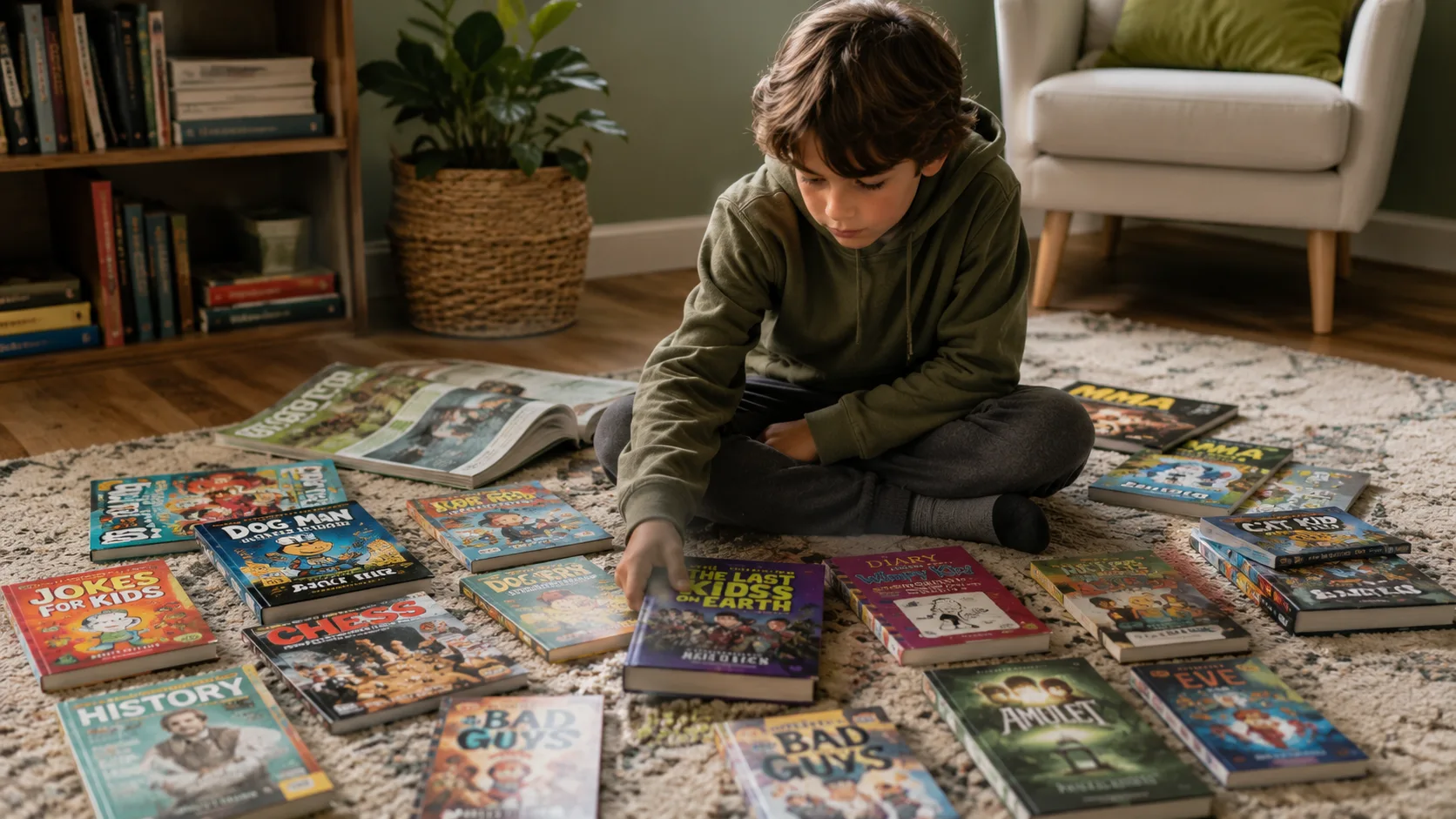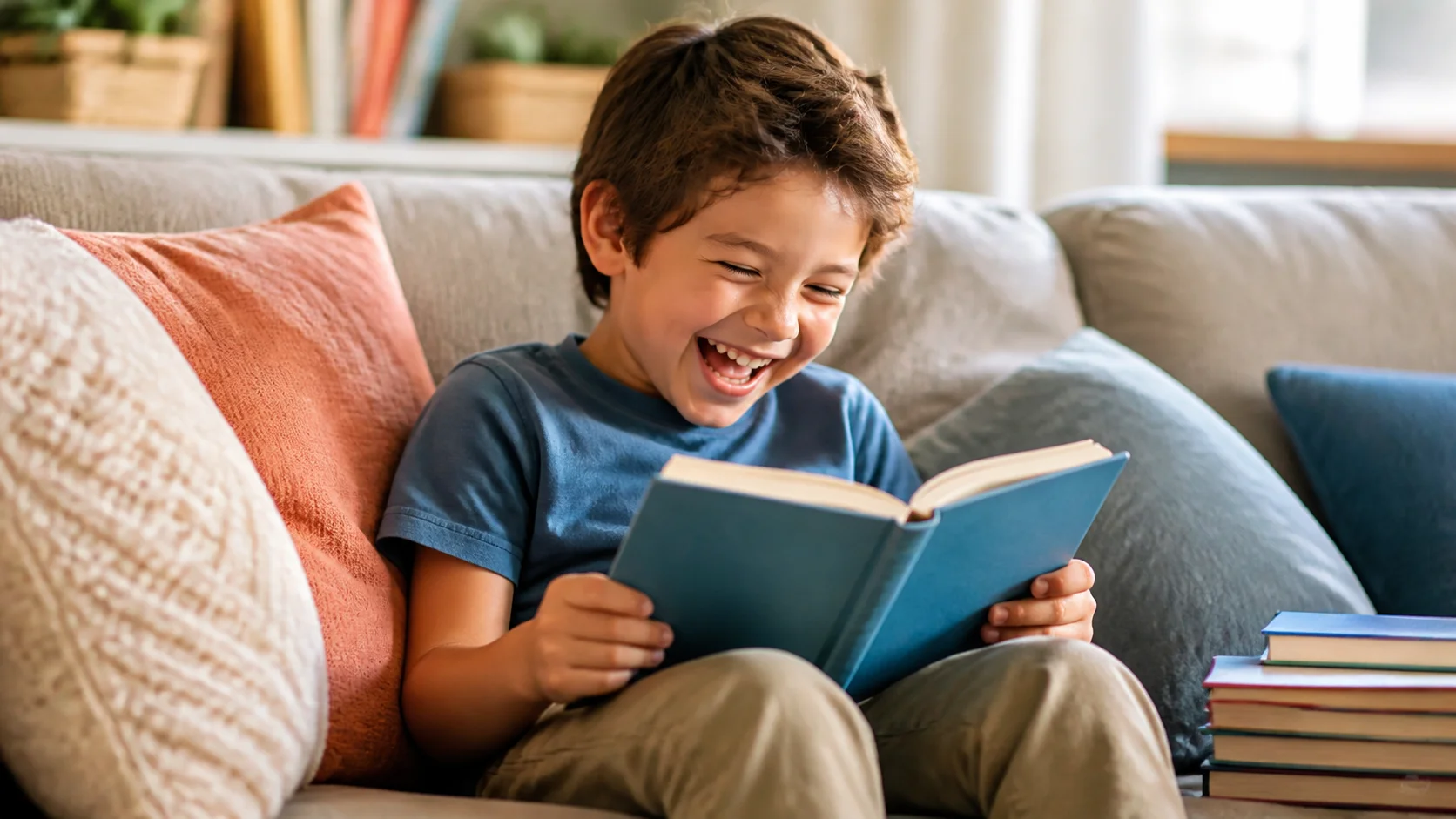

Ask a reluctant reader to "just read something" and you'll get a groan. Hand the same child a book of fart jokes, a comic where everything goes wrong, or a story so silly they snort — and something shifts.
That's not a trick. Funny books for kids are one of the most reliable ways to get a resistant reader reading, because humor quietly removes the things that make reading feel hard: the pressure, the boredom, the sense that this is a test they might fail. When a book makes a child laugh, reading stops being something done to them and becomes something they want more of. The interesting part is why that works so well — and once you understand the mechanism, you can use it on purpose.
Funny books for kids work because humor does four things at once: it hooks a child's interest, lowers the stakes of reading, rewards re-reading, and gets kids sharing what they read aloud. For a reluctant reader, a book that makes them laugh turns reading from a chore into a choice — and a child who chooses to read is a child who reads more.
Why "read this funny book" works when "just read" doesn't
"Just read" asks a child to do something effortful for no obvious payoff. "Read this funny book" offers an immediate reward — a laugh — for very little cost. For a child who has decided reading isn't for them, that swap is everything. Humor gets a foot in the door that instruction can't, and once a child is reading willingly, all the good things that come from reading volume start to follow.
Crucially, when children are allowed to choose their own books, humor is one of the things they reach for most — yet it's often the hardest kind of book to find in a classroom.1 Meeting a reluctant reader where their taste already is, rather than where we wish it were, is half the battle won.
Why humor makes reading easier: four reasons
Humor isn't just pleasant — it does specific, useful work for a developing reader. Here are the four mechanisms that matter most.
Children pay attention to, and persist with, things they find interesting — and interest, once sparked, can grow into a lasting habit.2 Humor is close to universally appealing, which makes it one of the easiest on-ramps to engagement there is.
Why it helps: an engaged child reads for longer, and reading volume is what builds vocabulary and fluency over time.3
A lot of reading reluctance is really anxiety — the fear of getting it wrong, looking slow, or being tested. It's hard to feel anxious and amused at the same time. A funny book feels low-risk, so a child will try it where a "proper" book feels like a trap.
Why it helps: when reading stops feeling like a test, a resistant child is willing to actually start — and starting is most of the problem.
Kids re-read the joke that landed, the panel that made them laugh, the silly line — again and again. That repetition quietly builds reading fluency. And the wordplay in puns, riddles, and rhymes exercises the sound-play that underpins decoding.4
Why it helps: re-reading for fun is fluency practice a child does willingly, without being asked.
A funny line begs to be read aloud — "listen to this!" Kids share jokes with parents, siblings, and friends, which turns solo reading into connection and gives them real reasons to read aloud.5
Why it helps: reading aloud to share builds confidence, and the social payoff keeps a child coming back to the page.
The throughline is interest and engagement. Given the choice, children gravitate toward humor and popular formats,1 interest sustains the attention that reading requires,2 and the volume of reading a child does is strongly linked to their vocabulary and fluency growth.3 Funny books are simply a very efficient way to buy more willing reading — which is the input everything else depends on.
What counts as a funny book (more than you think)
"Funny book" is a wide category — and for a reluctant reader, the unconventional formats are often the most effective. Let your child's sense of humor lead; gross-out, slapstick, and wordplay are all legitimate doors in.
| Type | Best for | Why it works |
|---|---|---|
| Joke & riddle books | Quick wins | Tiny bites of text, instant payoff, perfect for sharing aloud. |
| Comics & graphic novels | Resistant readers | Visual support plus humor keeps a wary reader engaged. |
| Wordplay, pun & rhyme books | Early readers | Sound-play supports the phonological awareness behind decoding. |
| Illustrated funny chapter series | Building stamina | Humor carries a child through longer text than they'd normally manage. |
| Fact & "gross science" books | Curious kids | Funny + true; reading with a real purpose they care about. |
| Personalized funny books | Making it theirs | The child is the hero of the joke — choice and laughter in one. |
How to choose funny books that actually help
Follow their humor, not yours
Gross-out, slapstick, wordplay, deadpan — let your child's taste lead. The "best" funny book is the one that makes them laugh.
Match the format to the reader
Joke books and comics for a resistant reader; funny chapter series once they're ready for more text. Meet them where they are.
Keep it at the right level
Funny and easy is the winning combination. If decoding the joke is a struggle, the humor never lands — go easier.
Lean into reading aloud
Invite them to read the funny bits to you. Sharing a laugh is reading practice that doesn't feel like practice.
Don't grade the funny
No comprehension quiz on a joke book. The moment a funny book becomes homework, it stops working. Let it just be fun.
Make at least one of them theirs
A book a child owns — or stars in — carries extra pull. Personalization turns "a book" into "my book."
When the funniest book of all is one starring your child
The pull of a funny book gets even stronger when the joke is about the reader. A personalized funny book combines two of the four mechanisms at once: the child gets a story that's unmistakably theirs (interest and ownership), and it's built to make them laugh (engagement and low stakes). When a child is the hero of a silly, surprising adventure with their own name on every page, picking it up doesn't feel like reading — it feels like fun that happens to involve words.
A personalized prank book where your child stars in the jokes
A humor-first storybook built around your child by name — exactly the kind of laugh-out-loud, low-pressure book that gets a reluctant reader turning pages. Best for children whose reluctance is about interest or boredom, not a decoding difficulty.
See the personalized prank book →When funny books aren't the whole answer
Humor is a powerful way in, but it's a motivator, not a method — it gets a child willing to read; it doesn't teach the mechanics of reading. If your child isn't just unenthusiastic but actively struggling to sound words out, or refusing books entirely with real distress, the issue may be a skill barrier rather than a lack of funny books.
If that sounds familiar, it's worth reading the bigger picture: our guides on what to do when your child refuses to read and building reading motivation at home cover how to tell interest problems from skill problems — and when to bring in a teacher or specialist.
- Persistent, effortful struggle decoding words well beyond what's typical for their age.
- Signs sometimes linked to dyslexia, or avoiding reading aloud entirely. Only a professional can assess this.
- Avoidance paired with real distress or a sharp drop in confidence.
This article is general guidance, not a diagnosis. A teacher or literacy specialist can tell you what your specific child needs.
The bottom line on funny books for kids
Funny books for kids work because they make reading feel like a reward instead of a requirement. Humor hooks interest, lowers the stakes, rewards the re-reading that builds fluency, and gives kids reasons to read aloud and share. For a reluctant reader, that's not a distraction from "real" reading — it's often the shortest path to it. Follow your child's sense of humor, keep the books easy enough to enjoy, and let laughter do the work that pressure never could.
The best book for a child who won't read is rarely the most improving one — it's the one that makes them laugh so hard they forget they're reading at all.